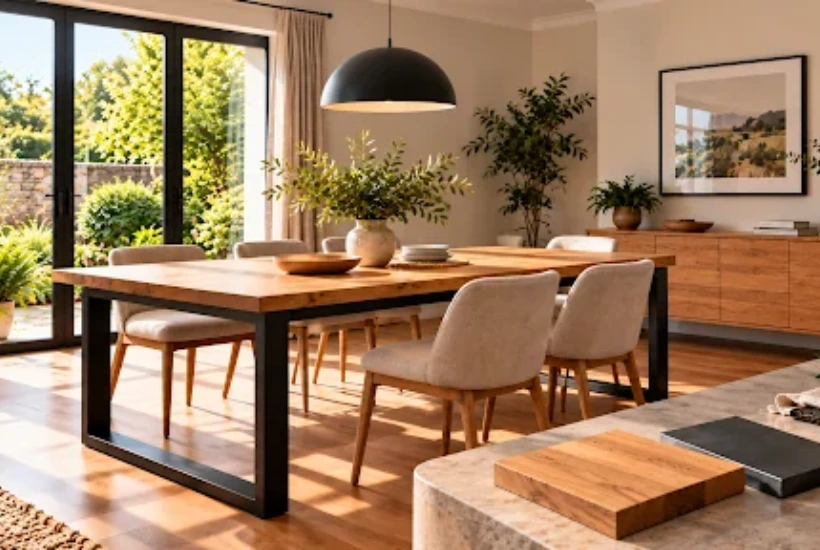
Pick up a steel stool and a solid oak one of the same size, and you learn most of what matters in a second. One is cold, light and precise. The other is warm, heavier and slightly irregular. Neither is better. They behave differently, and a custom piece lets you choose which behaviour suits the room.
This comparison covers the points that change a decision: strength and weight, feel, care, cost, and how to combine the two.
Strength and thin sections
Steel is stronger for its thickness. A steel table frame can be slim, with thin legs and long spans that would look spindly or fail in timber. That is why metal is the usual choice for slender shelving, open bases and cantilevered designs.
Solid wood needs more section to do the same job. Legs are chunkier, rails deeper, and joints larger. That bulk is part of its character, and well-made timber joints can last for generations. Wood has one more quirk: it moves. It swells and shrinks with humidity across the grain, so a good design leaves it room to do so.
Weight and moving
Metal frames are often lighter than they look when tubular or folded from sheet, though solid steel bar can be very heavy. Timber tends to be heavy in thick sections, and a solid oak dining table may need two or three people to lift.
If you move often, use the piece on a balcony, or plan to rearrange the room, check the weight early. Some makers can split a large piece into sections that bolt together.
Warmth, sound and touch
Wood is warm to touch and quiet. A cup placed on it makes a soft sound, and the grain adds visual interest. Metal is cool, reflects light and can ring when knocked. It suits modern and industrial rooms, and in contrast with timber it can make wood look richer.
Surfaces matter. A brushed or powder-coated finish on metal feels softer than polished steel and hides fingerprints better. A matte oiled finish on wood feels closer to bare timber than a thick gloss lacquer.
Care and longevity
Timber can be refreshed. An oiled top that gets scratched or marked can be sanded lightly and re-oiled, and rings from hot mugs or glasses often come out. A lacquered top resists stains better but usually has to be refinished across the whole surface if damaged.
Metal depends on its coating. Powder coating is tough and easy to wipe, though a deep chip can rust if the steel beneath is bare. Raw or waxed steel develops a patina some people love, while stainless and aluminium resist rust but can scratch. Brass and copper tarnish unless lacquered.
For outdoor or damp use, say so at the brief stage. The right timber species, the right coating and the right fixings are different from those used indoors.
What drives cost
Cost depends less on the material name than on the work involved. Metal frames need cutting, welding, grinding and finishing, and a clean weld takes skill. Solid timber needs good boards, careful selection, joinery and finishing, and a wide single-board top can cost a good deal more than a laminated one.
Ask the maker to price a couple of options. A steel frame with a veneered top may cost less than a solid hardwood table, while a hand-finished metal piece can cost more than a plain timber one. Choosing the finish that suits your budget, such as paint grade or a stained species, can also make a bigger difference than switching materials.
Mixing metal and wood
Combining the two is often the best solution: slim steel legs for lightness, a timber top for warmth. The combination suits dining tables, desks, consoles and benches.
Design details matter. Timber moves and steel does not, so fixings must allow for it. Elongated holes, sliding brackets or buttons let a solid top expand without cracking or bending the frame. A mismatch of colours is another risk: a black frame with a very pale top can look stark, whereas a mid-tone timber with a dark frame often looks balanced.
A maker offering bespoke furniture design should describe how the two materials will be joined, and show it on the drawings.
Finishes and colour pairing
Finish changes how both materials look and wear. On steel, a matte black powder coat is forgiving and modern, a clear lacquer over raw steel keeps the mill-scale look, and a blackened and waxed finish gives a deep, slightly uneven tone that suits a rustic room. On wood, oil keeps the grain visible and feels natural, while a hard lacquer is more resistant to spills and gives a more uniform look.
Pairing matters. A warm timber such as oak or walnut sits well on a dark frame, and a pale ash or maple suits a light grey or white frame. Brass or bronze details can tie the two together, and a single accent metal, such as brass feet or handles, usually looks better than three competing finishes.
Check the colours under your own light. Warm bulbs make timber glow and can turn a cool grey frame slightly beige, and daylight does the opposite. Ask for finish samples of both materials, and look at them side by side near the spot where the piece will stand. Photograph them in morning and evening light, because the pairing that looks balanced at noon can look heavy at night. If the piece will sit near a patterned rug or a coloured wall, bring a scrap of that too, so the decision is made against the real surroundings.
Heavy use, outdoors and children
Think about who and what will use the piece. A dining table takes elbows, hot plates and homework, so a hard-wearing finish and a thick top are worth the cost. A desk takes constant friction from forearms and a keyboard tray, so its edge profile and finish deserve attention.
Children and pets change the brief. Rounded edges, stable bases and finishes that tolerate scrubbing are sensible. Sharp steel corners should be softened, and anything that tips easily should be broader at the base or fixed to a wall.
Outdoors, the choice narrows. Hardwoods that tolerate weather, galvanised or properly coated steel and stainless fixings are the usual answers, and even these need regular care. Be specific about where the piece will live, because a table that is fine on a covered porch may not survive an open terrace.
Seeing it before it is made
Colour and proportion are hard to judge from samples alone. A 3D model of the piece shows how a slim steel frame looks with a thick oak top, how the edge detail reads and how the piece sits in your room. It is much easier to change a leg thickness on screen than after the frame is welded.
Ask for the model to show both materials in the finishes you plan to use, and compare against physical samples under your own light.
Which to choose
Choose steel when you want slim lines, long spans or a modern look and the surroundings are dry. Choose solid wood when warmth, repairability and a traditional feel matter. Choose a mix when you want both lightness and warmth.
For a piece that will take heavy use, such as a dining table or a desk, ask about thickness, bracing and finish. For a decorative piece, appearance can lead.
Conclusion: choose by use, then by looks
Metal and timber are not rivals but tools. Metal gives strength in thin sections and a crisp look, timber gives warmth and an easy repair, and together they offer both.
When you commission a piece, tell the designer where it will live, how it will be used and how much care you want to give it. Work with a designer who shows you the construction before you pay for it, and keep samples of both materials for the final decision. A good brief makes the choice almost obvious.
Related posts:
How Professional Exterior Painting Boosts Your Curb Appeal Instantly
Smart Garage Doors: Transforming Home Security in San Diego
Transform Your Space with Simple Exterior Improvements
How Texture Can Change the Entire Mood of Your Home
20+ Felt Christmas Crafts to Make with Kids This Holiday Season
15+ Christmas Decorations on a Budget To Make In

- Metal or Solid Wood? Choosing Materials for Custom Furniture - October 30, 2026
- Thanksgiving Hosting Hack: Where to Keep Extra Chairs, Tables, and Coolers - October 30, 2026
- How to choose a men’s wedding band: metal, width, fit and finish - October 30, 2026
Leave a Reply