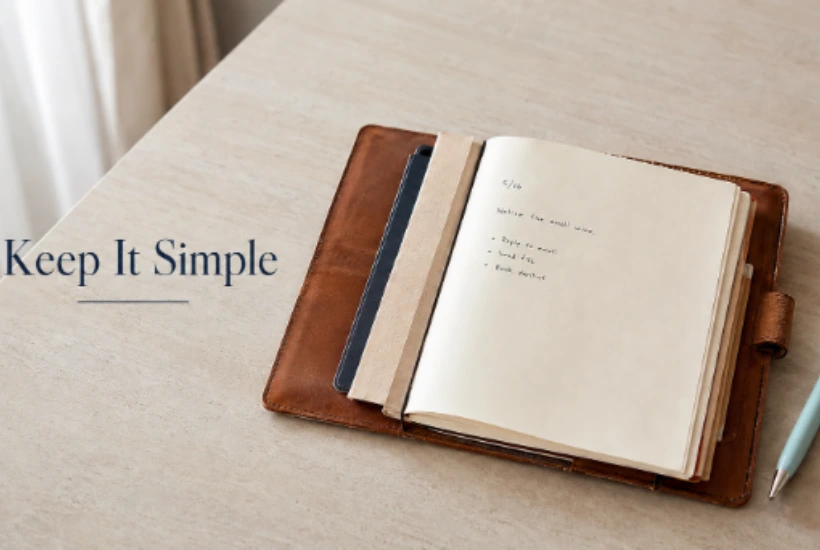
Many people stop journaling for the same reason they stop using complicated planners: the system begins to ask for more than it gives back.
At first, it feels exciting. You choose a notebook, look at page ideas online, create sections for goals, habits, reading, work, fitness, and personal reflections. Then a busy week arrives. You miss a few days, the blank spaces start to feel uncomfortable, and opening the notebook becomes another task on an already crowded list.
Minimalist journaling offers a different approach. It is not about making every page black and white. It is not about owning fewer pens or refusing to decorate. It is about removing the parts of a system that make it harder to begin.
The best journal is not the one with the most features. It is the one you still reach for on an ordinary Tuesday night.
Start with the smallest useful version
A journal does not need to hold every thought you have. It only needs to give important thoughts somewhere to go.
When you are building a lighter system, begin with three simple elements: the date, one thing that mattered that day, and one thing you do not want to forget. That could be a task you finished, a conversation that stayed with you, a short observation, or a reminder for tomorrow.
Some days, that may become half a page. On other days, it may be one sentence. Both are enough.
This small structure is useful because it lowers the cost of starting. You do not need to decide whether today deserves a full entry. You do not need to fill out a mood chart, a habit tracker, or a detailed reflection before you are allowed to close the notebook. You simply write what is useful and move on.
Over time, you may naturally add more. Perhaps you begin keeping a reading list, planning a trip, or working through a personal project. The difference is that these sections grow from your life, rather than being imposed on it in advance.
Choose a system that can change with you
A fixed notebook can work well when your needs stay the same. But most people move through different seasons. A busy work period may call for weekly planning. A holiday may create a need for tickets, addresses, and travel notes. A quiet month may leave more room for longer journal entries.
Starting over each time can make journaling feel expensive and wasteful. It can also make you hesitate to adapt, even when the current system no longer fits.
A premium Traveler’s Notebook cover can be useful in this situation because it allows the inside of the notebook to change without replacing the entire system. One refill might hold a few weeks of plans, while another becomes a place for everyday writing. When one purpose ends, you can remove that refill and add a new one.
The value is not in having more inserts. It is in giving each insert a clear job.
You might keep a simple planning refill beside a free-writing refill. Or you may use one notebook for a single project and another for daily notes. There is no need to build the perfect arrangement on the first day. Let the setup become clearer through use.
Replace daily perfection with a weekly reset
Minimalist journaling works best when it does not punish you for being busy.
If you miss a few days, do not go back and fill the empty pages from memory. Start again on the page you are on. The blank space is not evidence that you failed; it is simply a record of a time when you were doing other things.
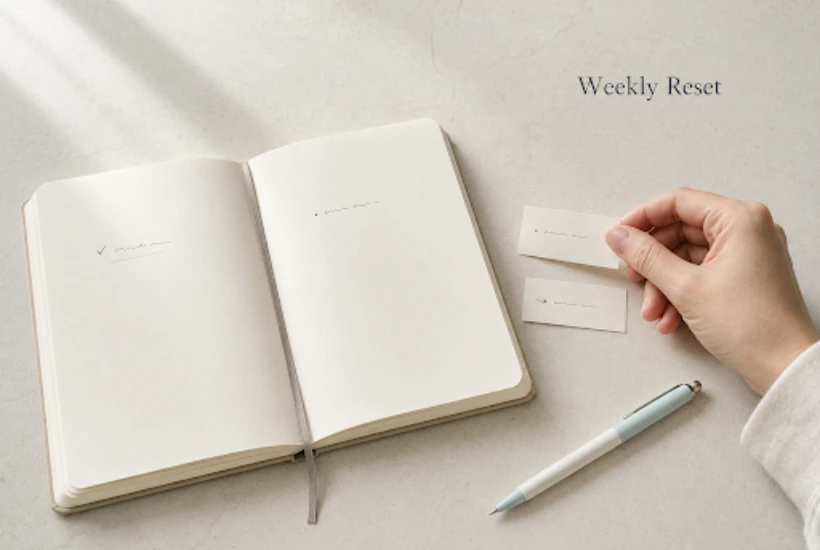
A short weekly reset can be more useful than trying to maintain a daily streak. Set aside ten minutes at the end of the week to look through recent pages. You can use that time to do three things:
- Move any unfinished task that still matters into the coming week.
- Mark a note, idea, or event you may want to find later.
- Notice which parts of the notebook you have not used at all.
This keeps the journal connected to real life. It also gives you permission to remove sections that sounded useful in theory but never became part of your routine.
For example, you may find that you enjoy writing a few lines each evening but never complete a habit tracker. The answer is not to become stricter. The answer is to stop reserving space for a tracker that does not help you. A lighter system is easier to return to because it reflects what you actually do.
Let your tools fade into the background
The tools you use matter, but they should not become the main event.
A pen that feels awkward, skips often, or makes you grip too tightly can add a small amount of resistance every time you write. On its own, that may not seem important. But journaling is built from repeated, ordinary moments. A tool that feels comfortable can make it easier to stay with a thought for another sentence or two.
For writers who prefer a steadier writing feel, vibration-free Zebra bLen is a relevant option to consider. The name is the required product phrase, but it is worth being precise about what the pen is designed to do: the bLen system aims to control writing vibration by reducing tip wobble and internal movement. It is not a promise of perfect silence or a cure for hand fatigue. It is simply a design choice that may make everyday writing feel more stable.
That is the right role for a writing tool in a minimalist system. It should support attention without demanding it.
The same idea applies to paper, tape, and accessories. Choose the details you enjoy using, but do not let them become conditions you must meet before you can write. If a plain page and one reliable pen are enough on a difficult day, then your system is doing its job.
Minimalist does not mean empty
It is easy to confuse minimalism with restriction. A minimalist journal does not have to be colourless, serious, or sparse. You can still use a favourite ink, add a ticket stub, draw a small sketch, or decorate the start of a new month.
The question is not whether something looks good. The question is whether it earns its place on the page.
A piece of washi tape may help you find a monthly section. A colour may help you separate work notes from personal ones. A sketch may help you remember a day more clearly than a paragraph would. These are all useful choices when they make the notebook feel more like yours.
What minimalist journaling removes is the pressure to do everything at once. You do not need to journal daily, plan perfectly, track every habit, or make each spread worth sharing. You only need a system that leaves room for your real thoughts and routines.
Edit the system after a month
After a month, spend a few minutes looking back through the notebook.
Which pages did you return to? Which sections felt easy to use? Which ones stayed empty? You may notice that your most valuable entries are not the carefully planned pages, but the quick notes you wrote when you were tired or distracted.
Keep those.
If something has not served you, remove it from the next refill. If you are repeatedly writing the same kind of note, give it a clearer place. If you have stopped using the notebook because it feels too full, simplify it again.
A good journal does not ask you to become a different person. It adapts to the person you already are.
That is the quiet strength of a minimalist system. It gives you a place to notice your life without turning the act of noticing into another obligation.
Related posts:

- 5 Ways to Reduce No-Shows for Kids’ Trial Classes - October 20, 2026
- 7 Creative Ways to Use Interior Wall Panels to Add Character to a Rental Property - October 20, 2026
- What Are the Signs Your Houston Home May Need Professional Attic Cleaning? - October 20, 2026
Leave a Reply