If a ceramic tree ever glowed on a table near you, hold on for #1: it tells you how to read the date on its bottom, and why that date can fool you.
The first week of December, the kitchen table got a newspaper tablecloth. On it went a saucer of paste, blunt scissors, a stack of colored paper that smelled like a school hallway, and glitter that would still turn up in the floor cracks at Easter.
Plenty of what got made there never got made again, and almost nobody noticed it stopping.
#25 Popcorn and cranberry garlands strung by hand

You needed a needle, a long doubled thread and more patience than most kids owned. Popcorn split if you pushed too hard. Cranberries squirted. Many people remember that the bowl of popcorn shrank much faster than the string got longer, and nobody could ever prove where it went.
The strings slipped out of most living rooms once shiny store garland got cheap, though nobody marked the year.
There’s still a good use for one. Sarah Browning, an extension educator with the University of Nebraska-Lincoln, suggests standing a real tree outside after Christmas and pushing popcorn and cranberry strings well into the branches.
The popcorn draws cardinals, finches and grosbeaks. The cranberries bring cedar waxwings, and any robins that stuck around for winter.
#24 Paper chains glued with flour paste
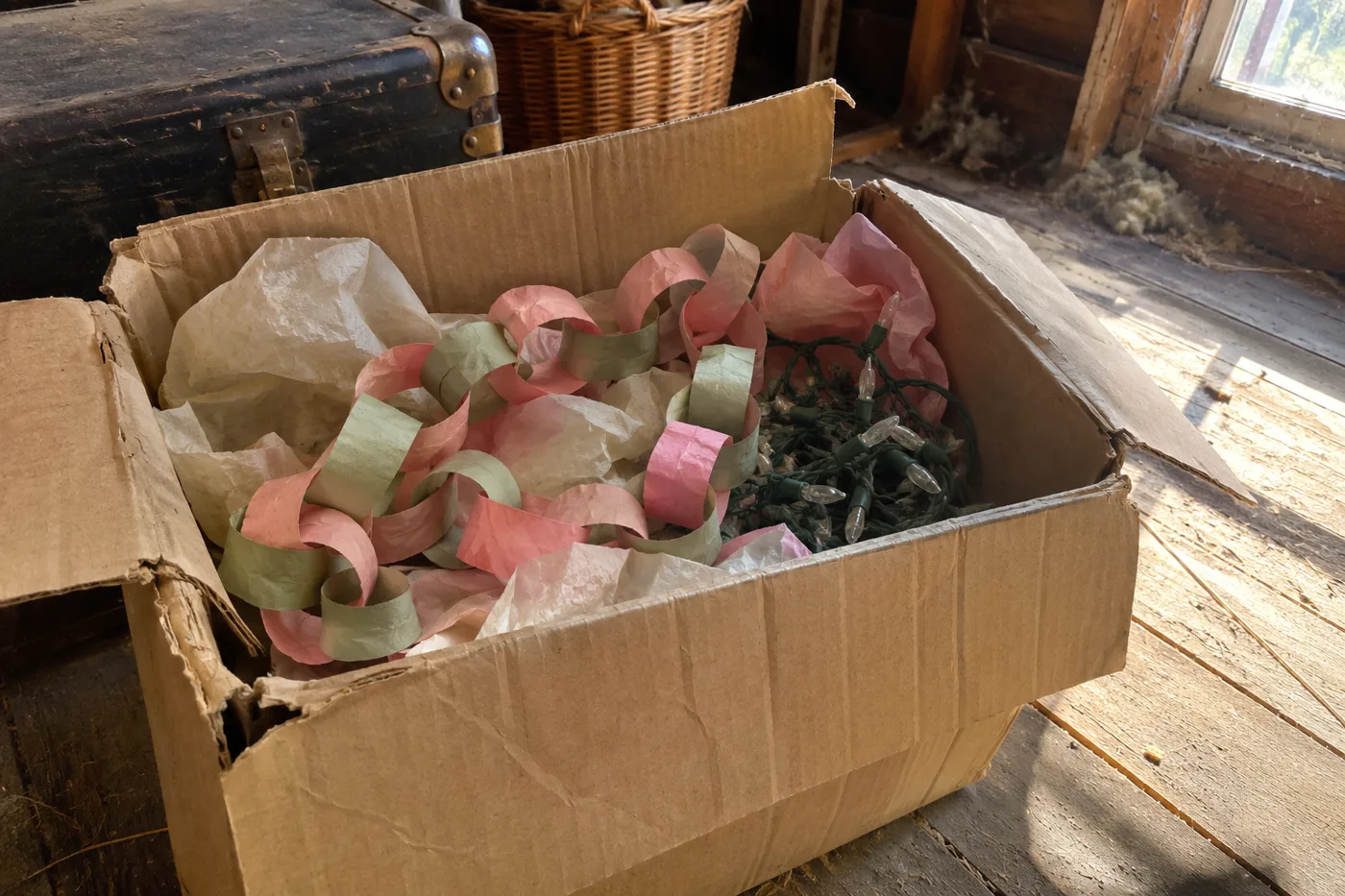
Flour and water in a saucer, stirred with a finger until it looked like pancake batter. That was the glue, and it held about as well as you’d expect.
The paper came in a thick pad of colors. It got the name construction paper in a 1911 school-supply catalog, and it was made cheap on purpose, for classrooms.
That cheapness is why old paper chains look so washed out. Paper conservator Joan Irving explains that the dyes in construction paper fade badly. That’s what became of the few that got saved: if a chain from long ago still lives in a box somewhere, its pale loops may once have been much brighter.
#23 Egg-carton cups cut into tiny bells
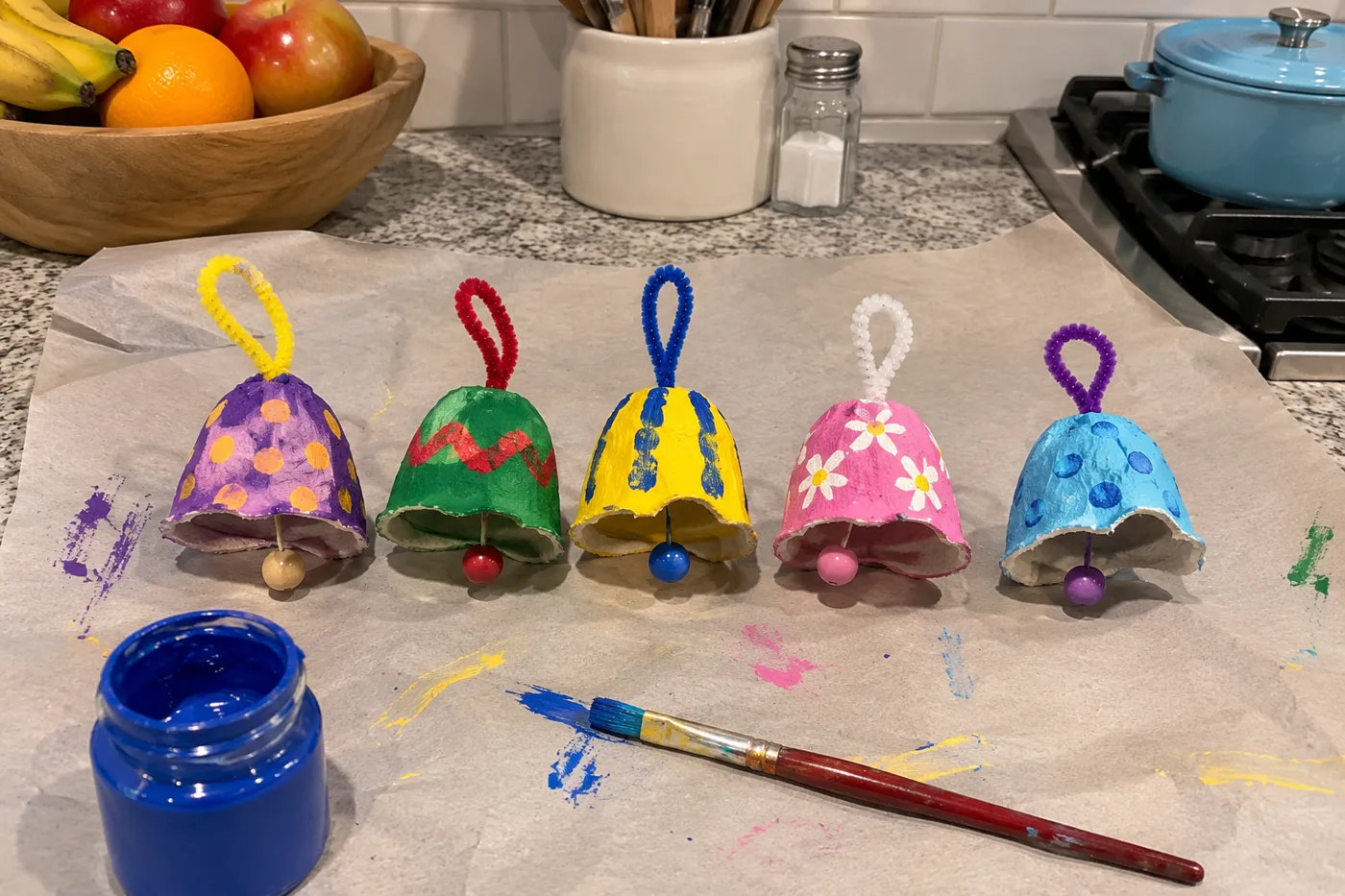
Twelve little cups, already shaped like bells. All a carton needed was scissors, some poster paint, and a pipe cleaner poked through the top with a bead on the end for a clapper.
Those bells came from the gray paper-pulp cartons, the kind that took their bumpy shape around the 1950s. Foam cartons showed up in the late 1960s, and they never felt right under a paintbrush.
#22 Macaroni shapes glued and sprayed gold
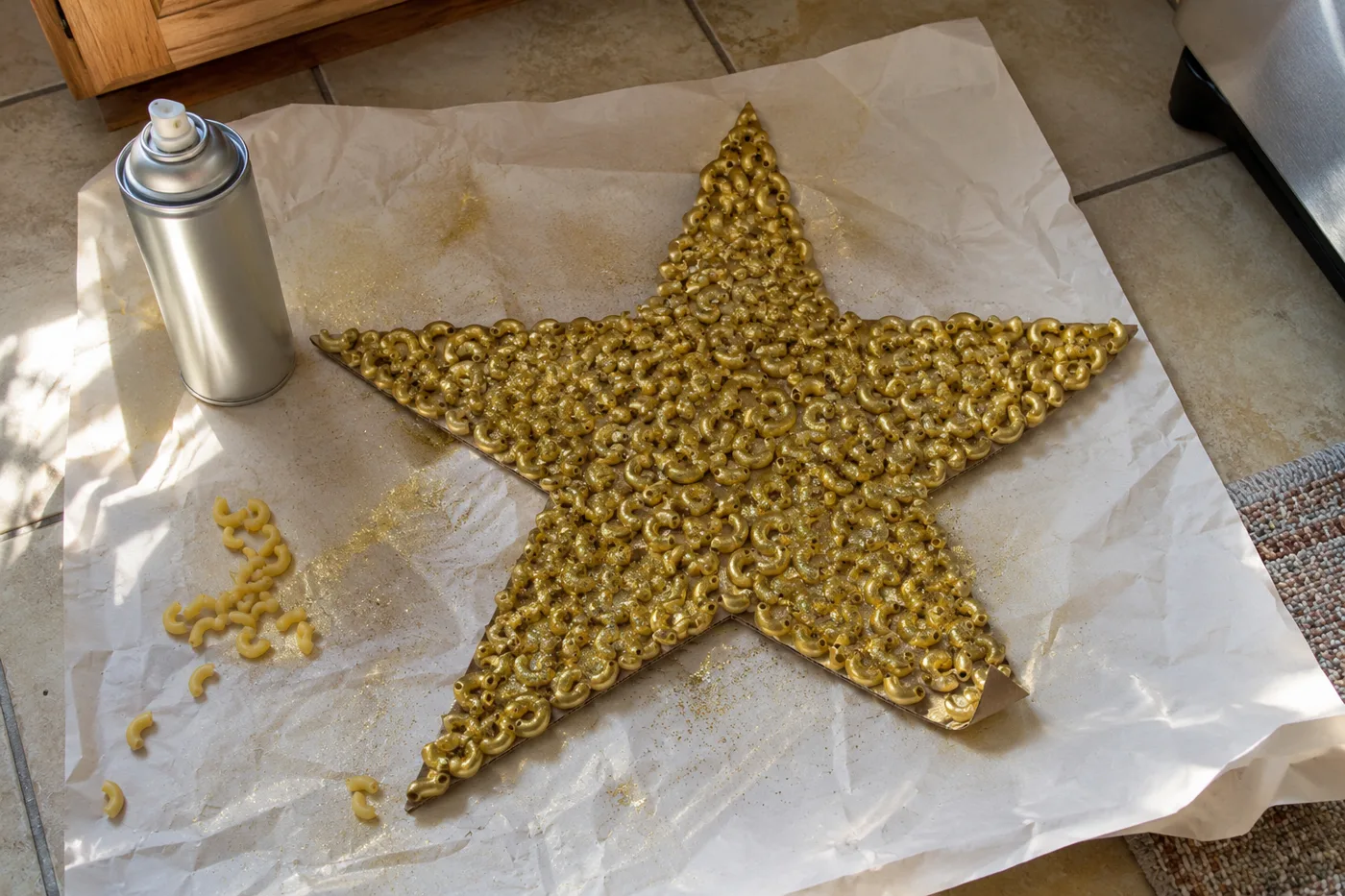
A star cut from a cereal box, elbow macaroni glued edge to edge, a can of gold spray paint shaken until the ball inside rattled, and glitter thrown on while the paint was still wet. One writer remembers making exactly that in first grade in 1963, plus a sticky floor afterward.
It wasn’t only for kids. A December 1962 newspaper craft told readers: “Spray what you have so far completed, with gold spray paint.” Gold spray was already a household holiday tool.
#21 A gumdrop tree stuck with toothpicks
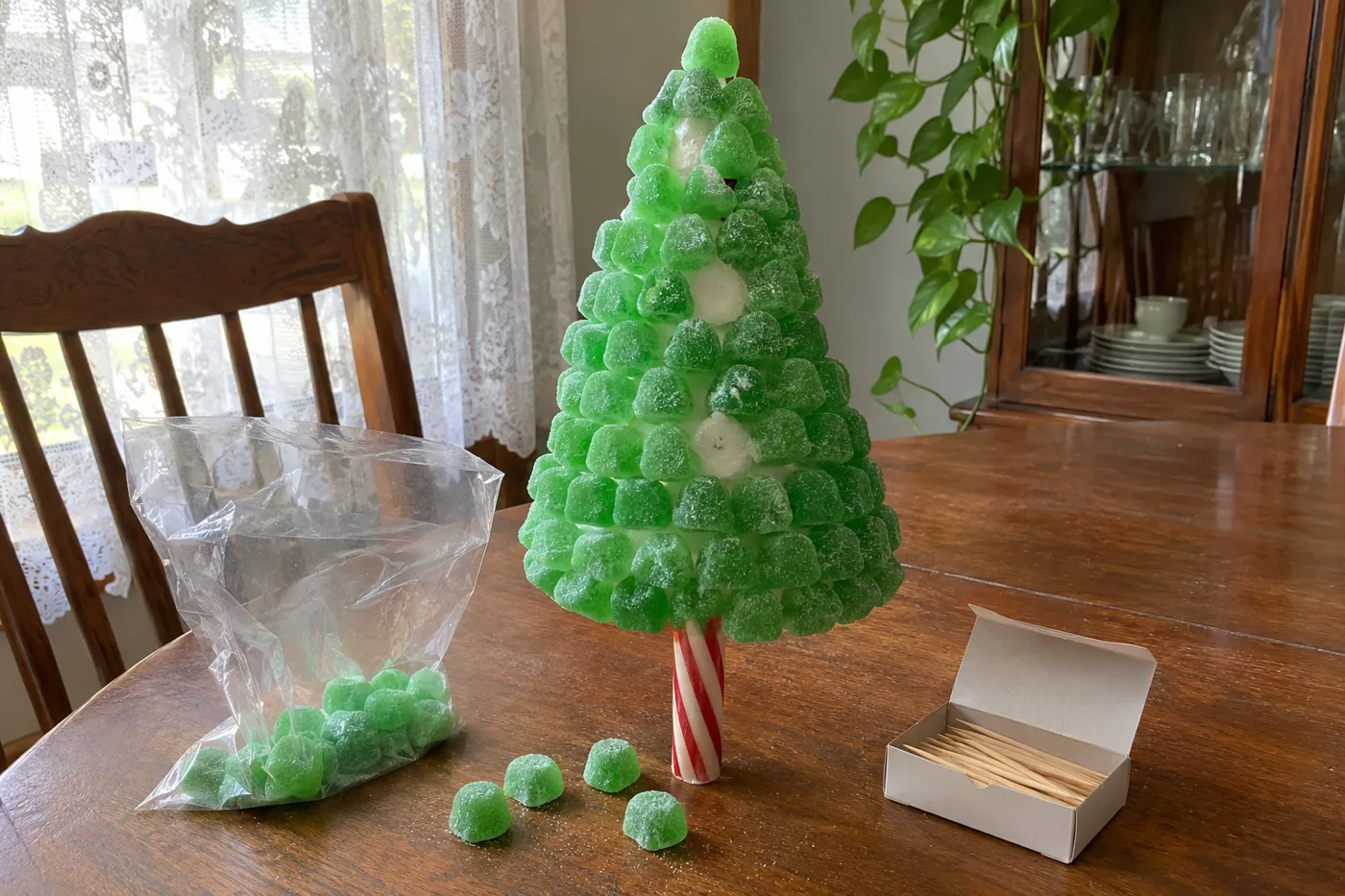
It sat on the dining table, green and sugary, and it got a little smaller every day.
A 1966 set of instructions set a Styrofoam cone on an upside-down bowl and pinned spearmint gumdrop “leaves” on with toothpicks, in overlapping rows so they’d hide the toothpicks and look like a fir. Peppermint sticks made the trunk. The big 24-inch version took about three hours and around $5 in candy.
It went the way of any candy on a dining table: eaten, one gumdrop at a time.
#20 Old cards folded and glued into balls
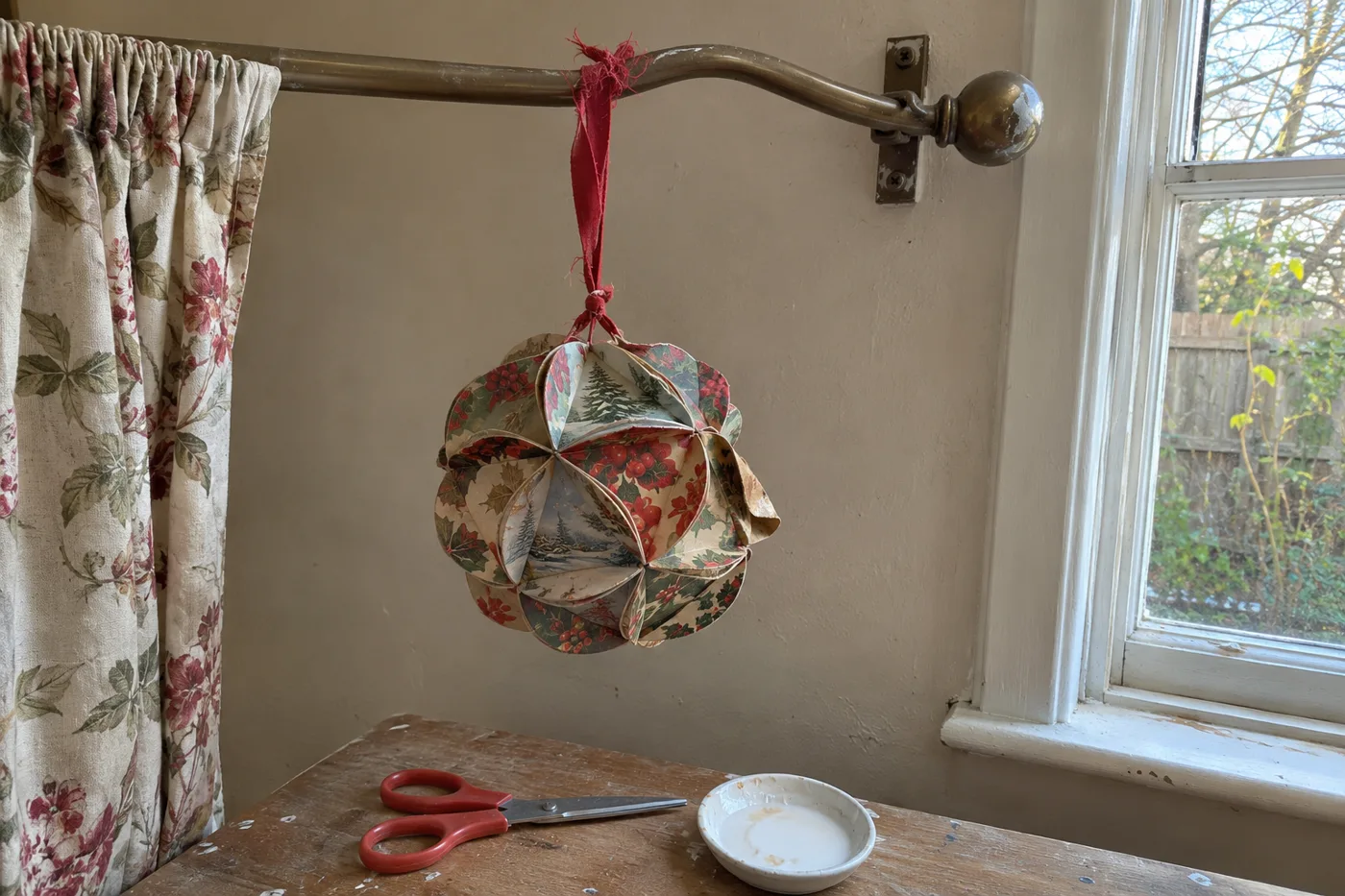
Last year’s cards had a second life in a lot of houses. You cut about 20 circles from old cards, and the finished ball came out covered in little pictures of snow, churches and cardinals.
The trick is a triangle. You draw one on the back of each circle, score the lines (press them with a dull point so they fold clean) and fold the curved flaps up.
That leaves a triangle with flaps. Glue five of those together for the top, keep adding around the sides, and slip a ribbon loop in before the last one closes it.
Every face on that ball was somebody’s card. The craft lives on in how-tos like that one, so pull the cards out of the drawer before they go to recycling.
#19 Christmas cards taped around the doorframe
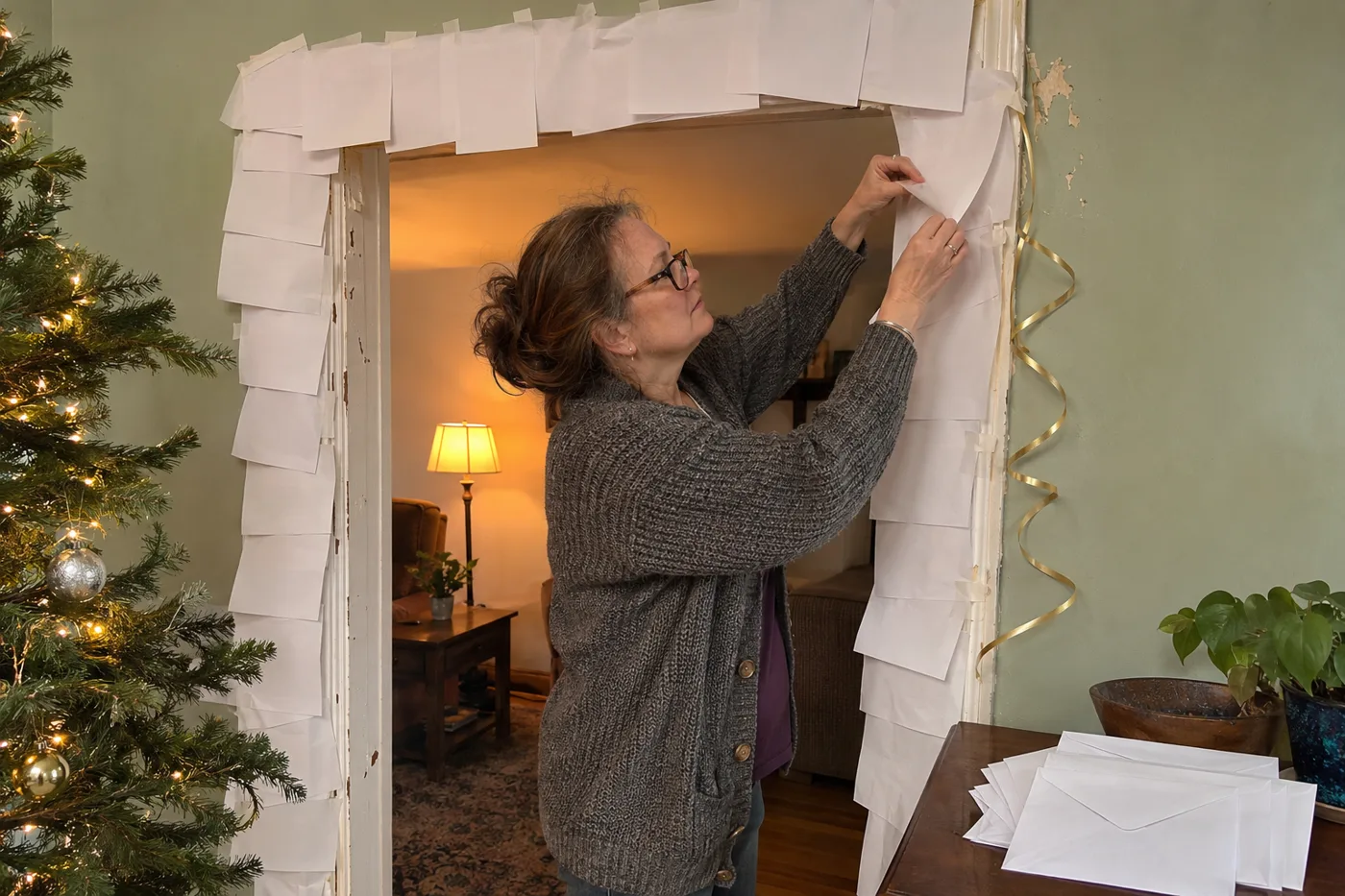
In a lot of houses the cards went up as they came in, with tape, a ribbon or a string, until the doorway to the living room looked like a picture frame.
It took a lot of cards. Americans mailed roughly 10 holiday cards for every person in 2002. By 2014 it was just over four apiece.
#18 A coat-hanger wreath wrapped in dry-cleaner bags
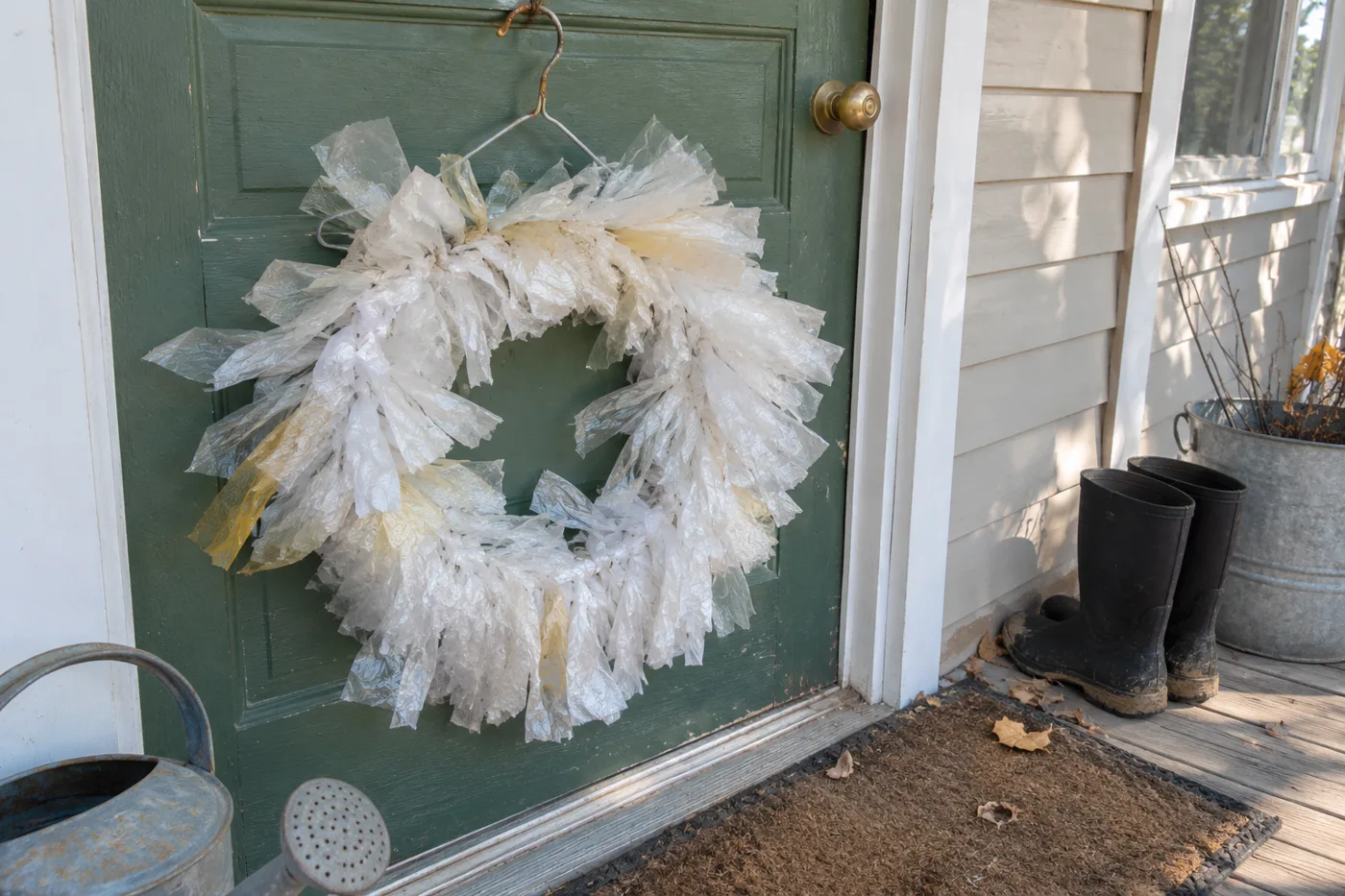
The clear plastic that came home over the good coat from the cleaner became a fluffy wreath on a wire hanger. From across the room, it looked like frost.
The bags were new then. Dry cleaners were wrapping clothes in plastic by 1956, and about a billion garment bags sold in the next couple of years. Every closet had a pile.
Those same bags soon carried a warning you may remember: “This bag is not a toy.”
#17 Frozen juice-can lids turned into ornaments
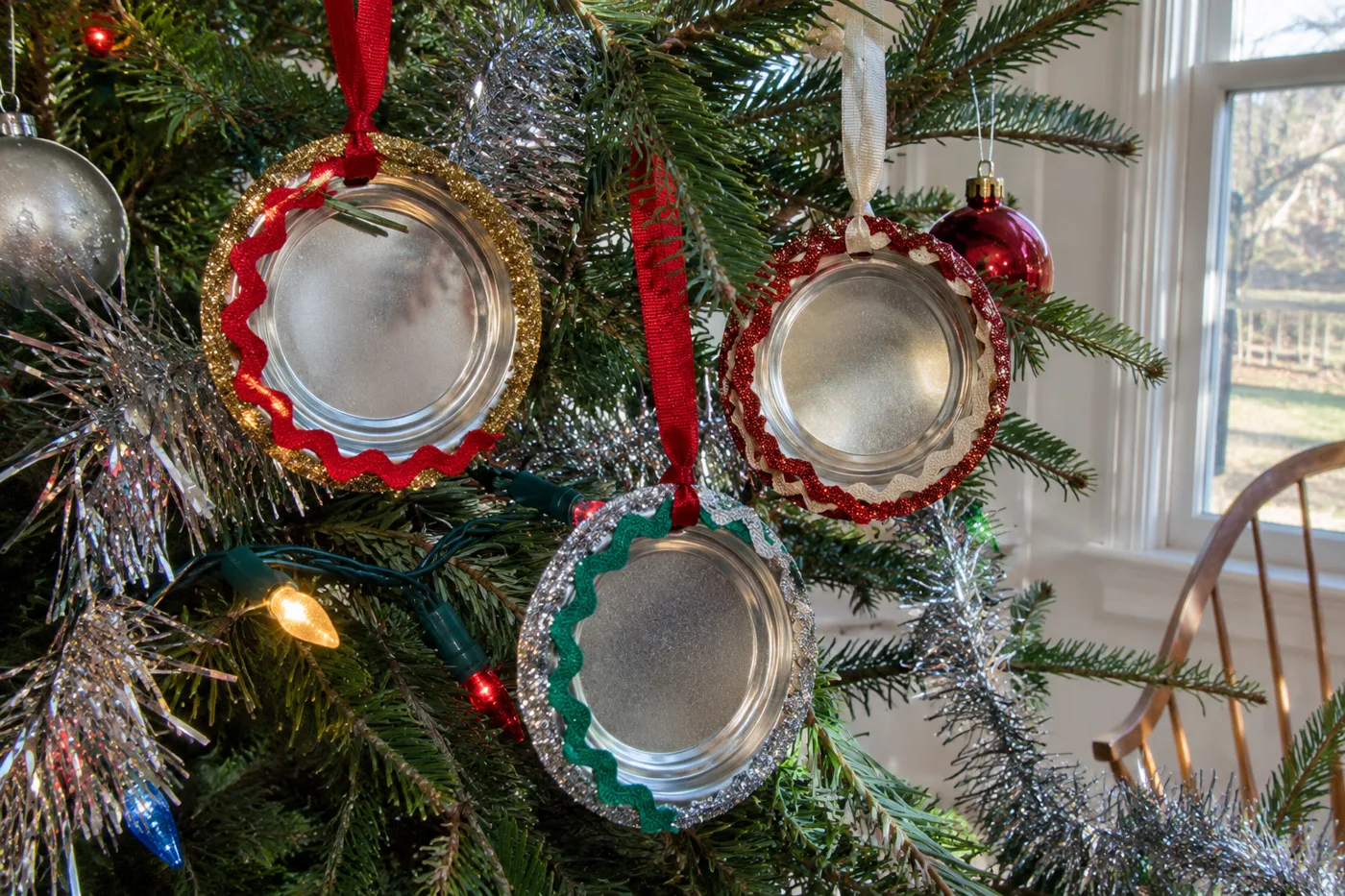
The shiny round lids off the frozen orange juice cans were too pretty to throw out. Glue on some glitter or a ring of rickrack, punch a hole with a nail, and you had a little mirror that caught every light on the tree.
Frozen orange juice was newer than it felt. Minute Maid first shipped it across the country in 1946. In 2026 Coca-Cola, which bought the brand in 1960, said it was leaving the frozen can business, with the concentrates gone from stores by April 2026, while supplies last.
Those shiny lids are harder to find now that Minute Maid’s cans are gone.
#16 Ice candles poured into milk cartons
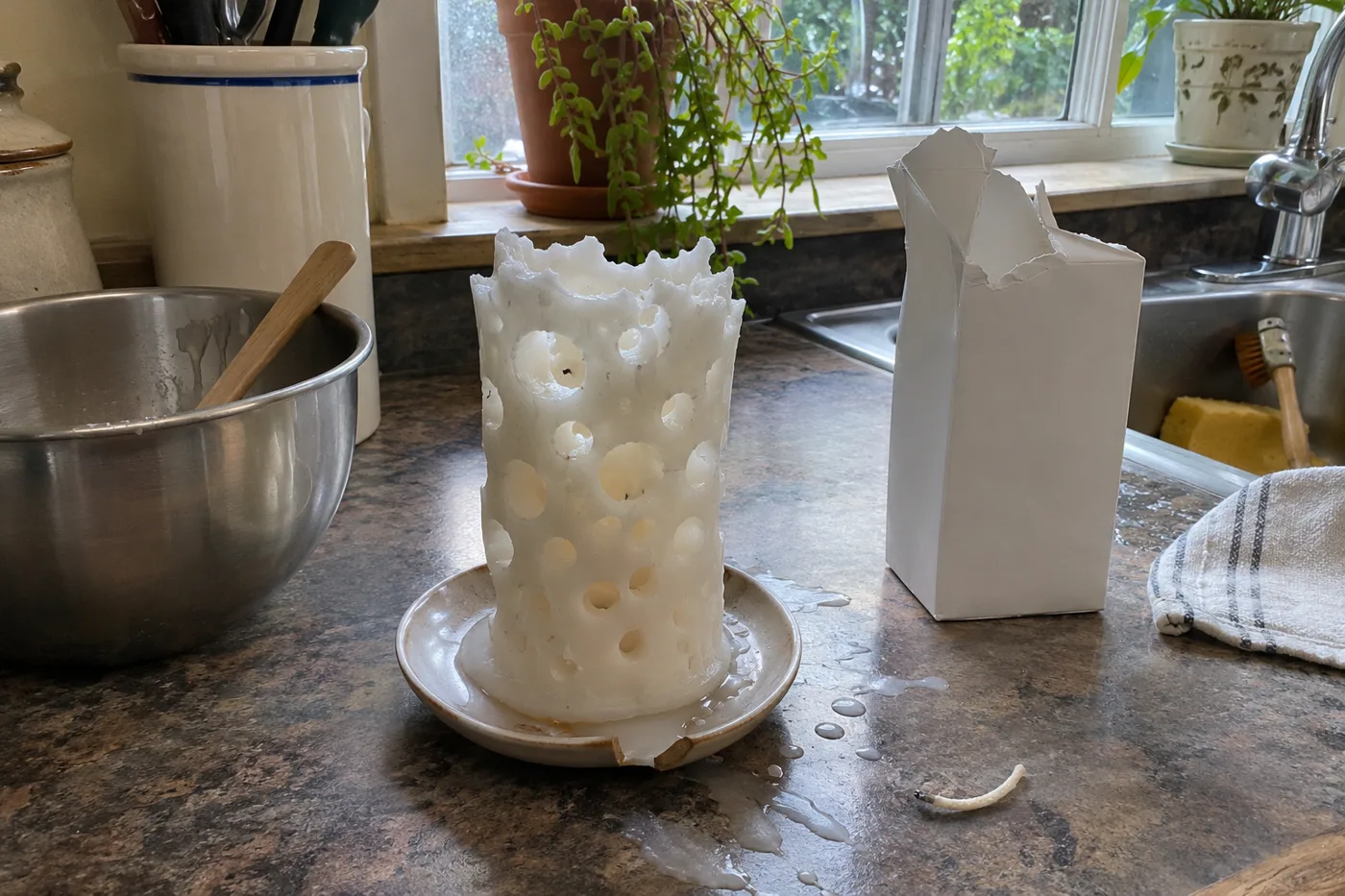
Rinse out a milk carton, stand a wick in the middle, pack chunks of ice around it, and pour melted wax over the top. Once it set, you poured the water out and found a candle full of holes, like Swiss cheese with a wick.
The milk carton people loved this one. Pure-Pak printed the ice-candle craft in its own ads in 1964 and again in 1967. A candlemaker quoted in a 1973 newspaper said cartons beat store-bought molds: they cost nothing, worked with cooler wax (under 190°F) and peeled away.
The carton came off in strips, and the candle underneath looked like lace.
#15 Bleach jugs cut into Santas and snowmen
Bleach used to come in heavy amber glass. Then in 1960 Clorox brought out a white plastic “safety bottle,” and by 1962 the glass was gone.
An empty gallon went from 3.5 pounds of glass to 3.5 ounces of plastic. Light enough to cut with kitchen scissors, light enough to hang on a door.
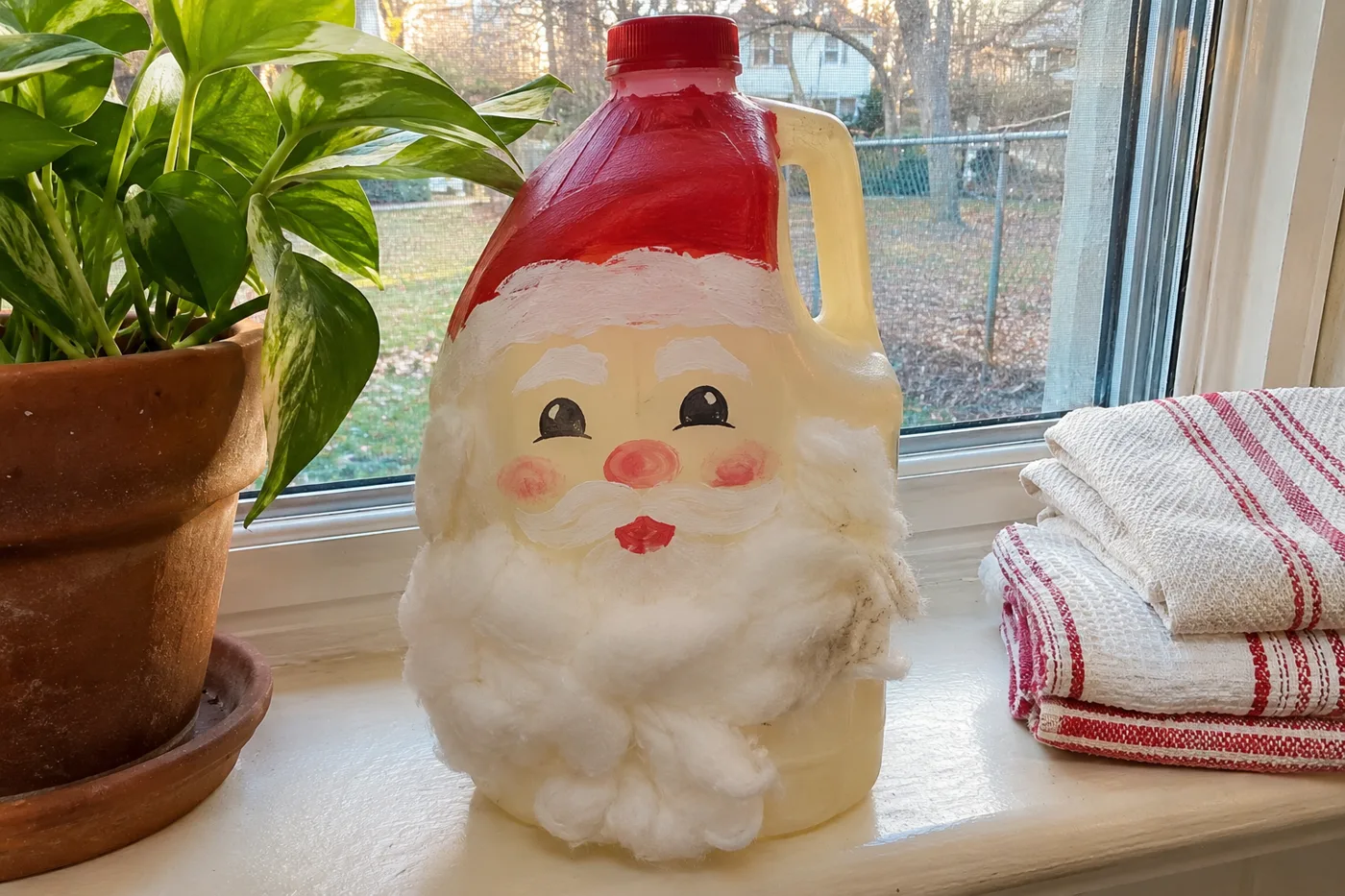
The jug got rinsed out, cut down, and painted into a face, with cotton glued on for a beard. Nobody did that with the heavy glass bottles that came before.
#14 Salt-dough ornaments shaped at the table
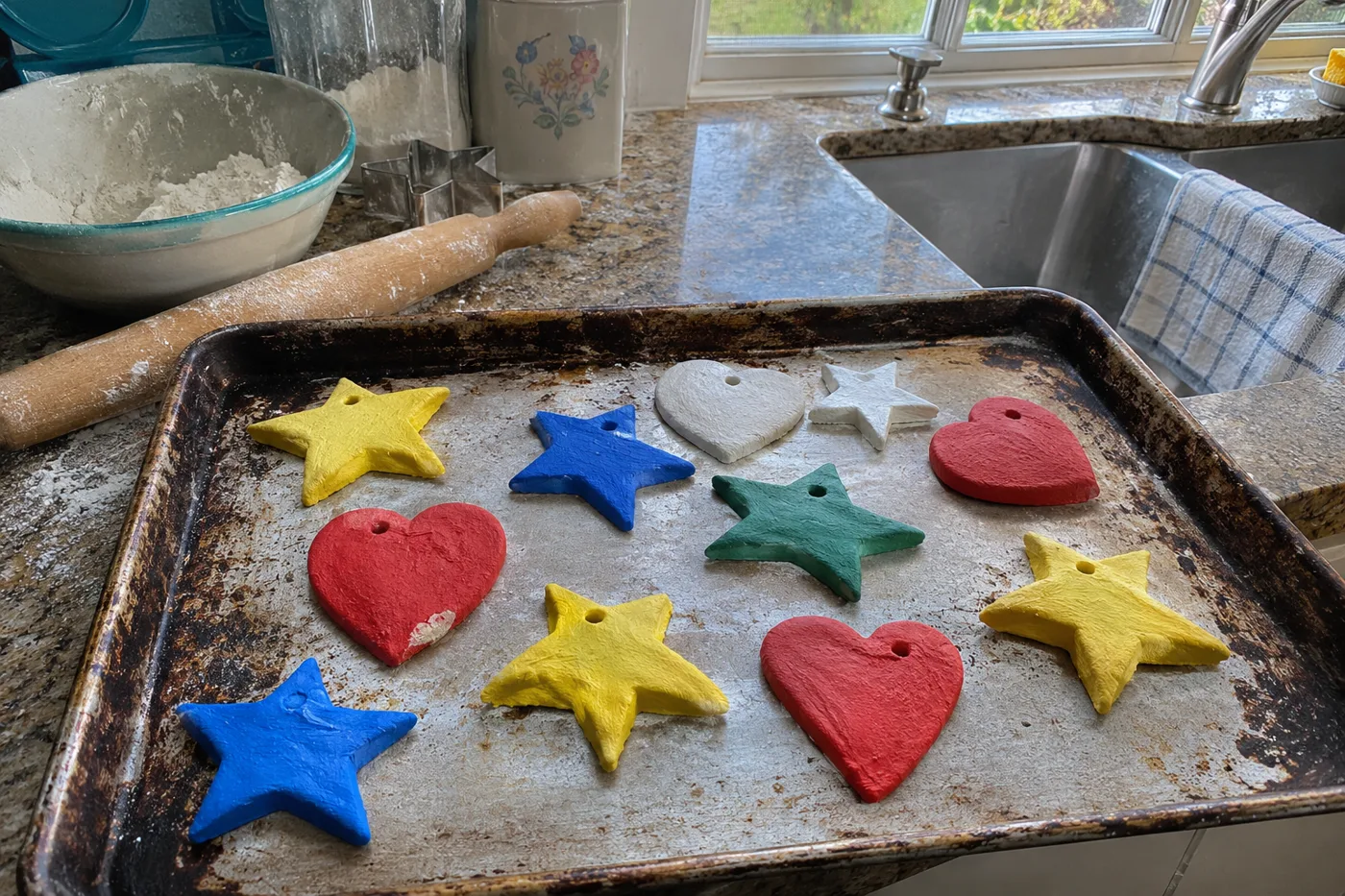
Salt, flour or cornstarch, water, a rolling pin, and the same cookie cutters used for the real cookies. Many people remember that one bite was enough to teach a kid it wasn’t food.
Dough ornaments traveled far beyond kitchen tables. In 1981 a newspaper story described women in Calderón, Ecuador, making bright bread-dough ornaments that ended up on trees around the world. That story’s writer, Maria Lenhart, also gave a home recipe, below.
Paint them once they’re dry, then varnish. Damp is what ruins these: water makes a finished piece fall apart. People still ask about salt dough in craft videos today.
The basic recipe
- 1 cup salt, ½ cup cornstarch and ⅔ cup water, cooked until you can shape it (the 1981 story has the details)
- Shape, then dry in a 200°F oven for several hours
- Paint, then varnish
- Makes about two dozen
#13 Gilded walnut shells hung on the tree
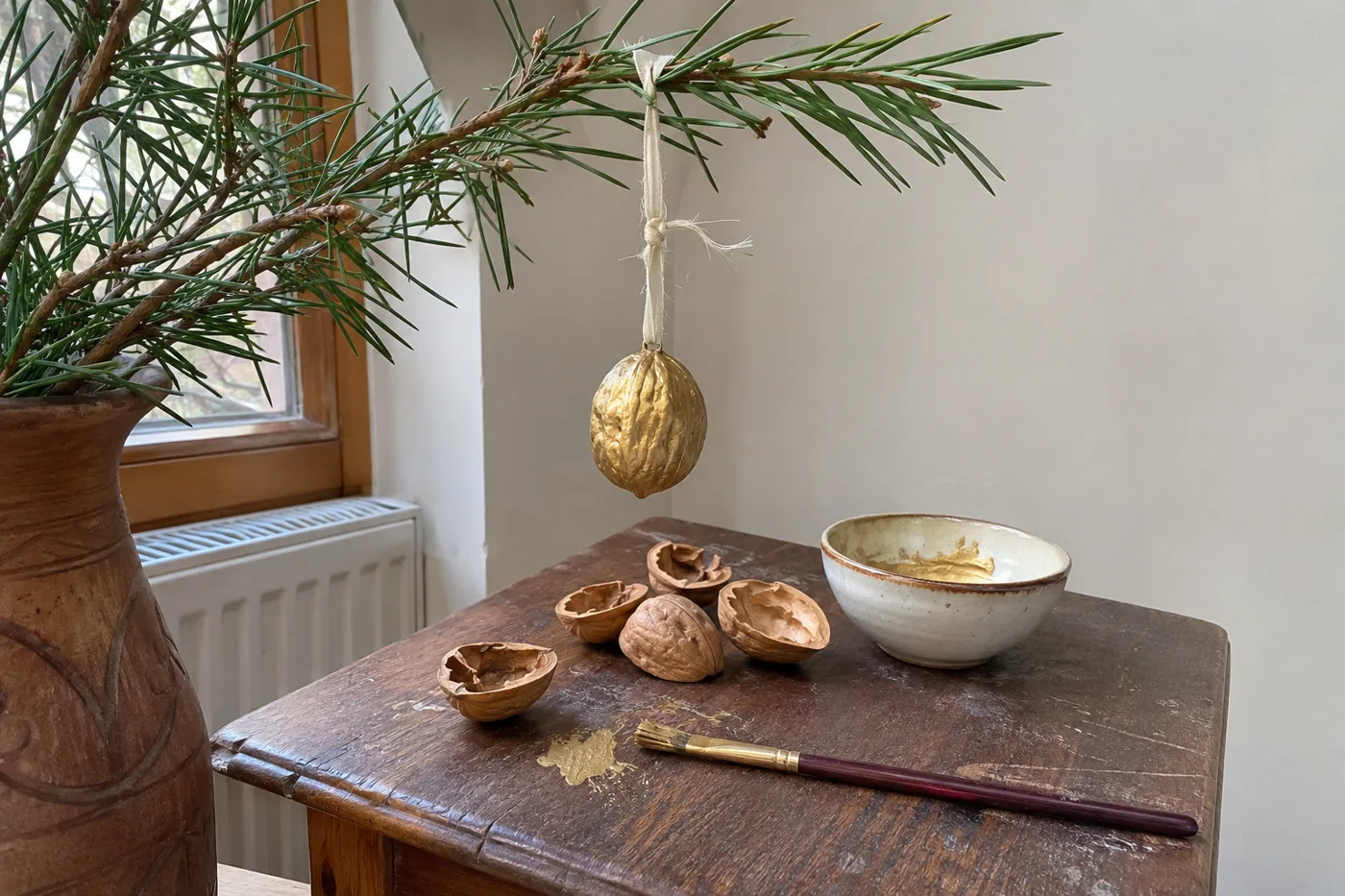
A walnut cracked into two neat halves, glued back together and painted gold. On the tree it looked like a solid gold nut.
This one is far older than the 1960s, which is why it felt like a great-grandmother’s trick.
An 1887 household magazine was already recommending gold paint for gilding walnuts and acorns, and a 1900 magazine suggested coating the nut in glue, rolling it in gold powder and tapping in a small tack to hold the string.
The hard part was always the cracking. Historian Dr Serena Dyer made them from period instructions and found cracking the shells neatly much harder than it looked. They’ve mostly gone out of use since. If you try it, buy more walnuts than you think you need.
#12 Orange pomanders studded with whole cloves
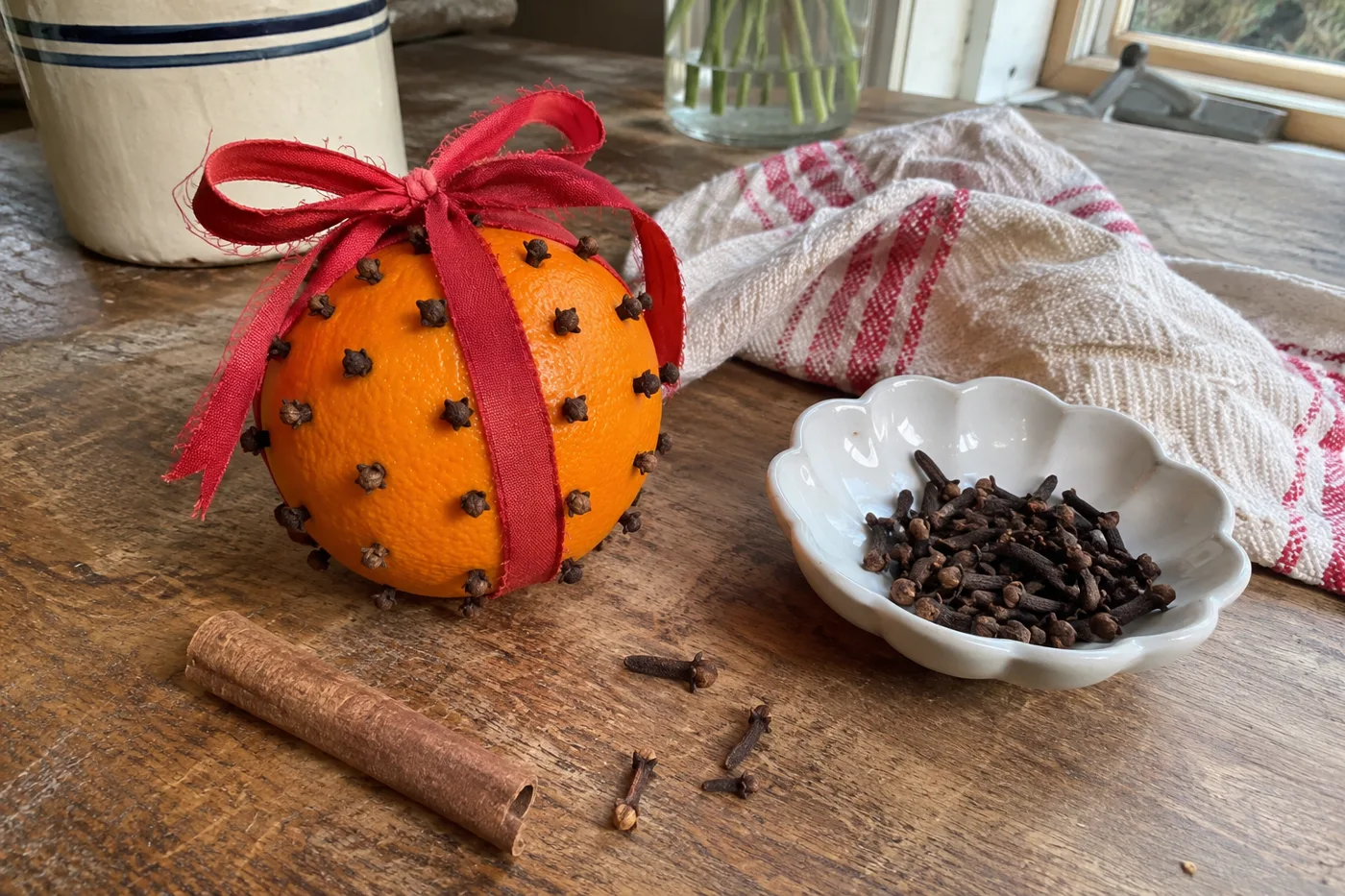
An orange, a box of whole cloves and a sore thumb by the end. You pushed cloves in until the skin was covered, tied a ribbon around it, and the whole room smelled like it.
Do you need to poke holes first? The Farmers’ Almanac calls it optional but helpful.
To make one last, the Almanac rolls it in 2 tablespoons each of cinnamon, nutmeg, ground cloves and orris root (powdered iris root, which holds the scent), then leaves it 2 to 4 weeks in a dark, dry spot.
The name comes from Old French: pomme d’ambre, an apple of amber. The directions are still in the Almanac, so this one never fully went away.
#11 Paper-bag luminarias lighting the front walk

Brown paper sacks with the tops folded down, a few inches of sand in the bottom and a candle set in the sand. Lined along a front walk or a whole block on Christmas Eve, they made the street glow.
They come from New Mexico, where Christmas Eve bonfires turned into paper lanterns once flat-bottomed paper bags became common in the late 1800s.
New Mexico never gave them up. In the north of the state they’re farolitos. South of Santa Fe they’re luminarias, and both sides are sure.
#10 Tin cans punched into glowing lanterns
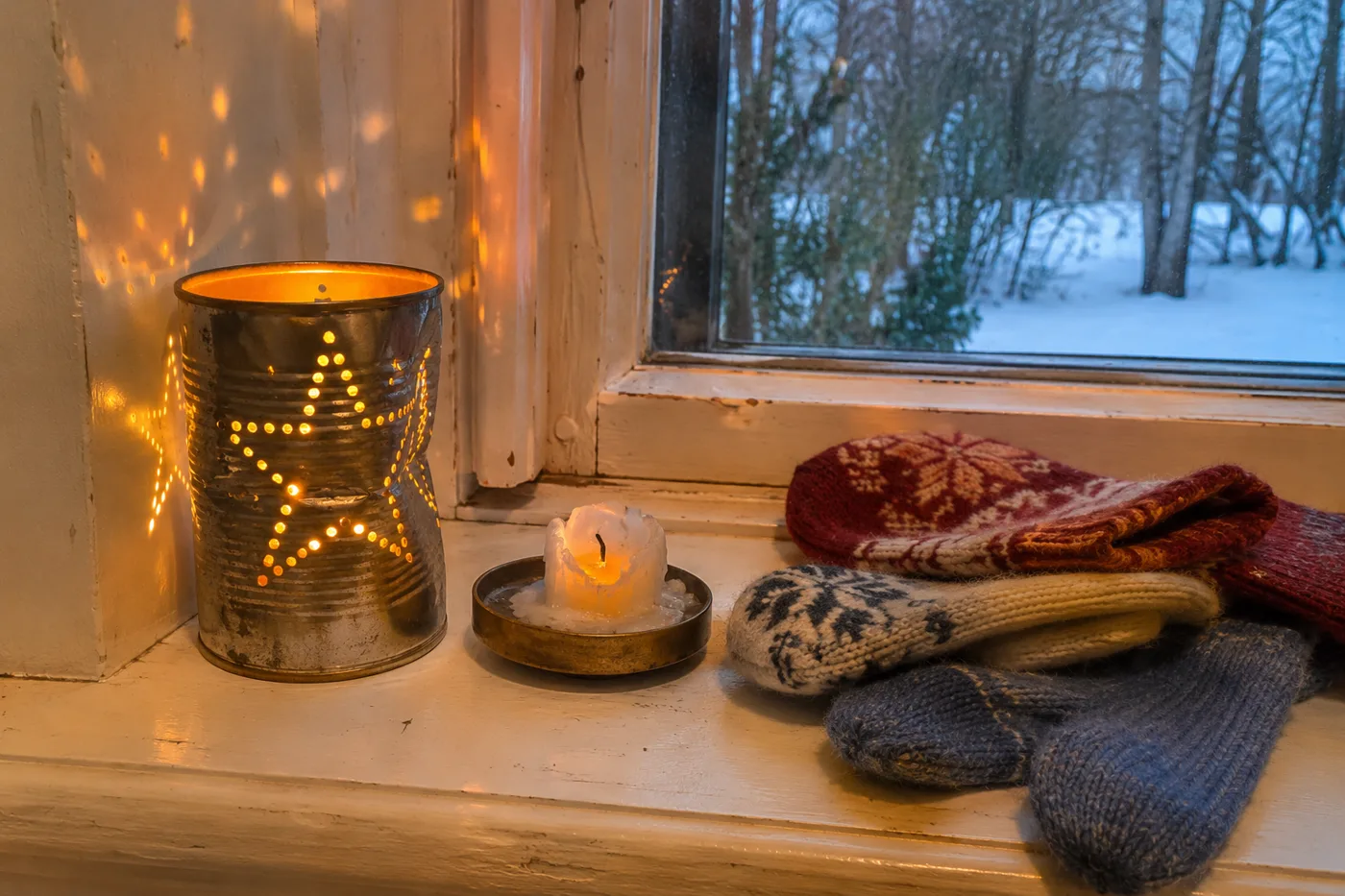
A soup can, a hammer, a nail and a paper pattern taped around the outside. Bang a star or a tree into it hole by hole, set a candle inside, and the pattern shows up as dots of light on the wall.
The catch is that a soup can dents the minute you hit it. Historic Deerfield, a history museum, has a fix: fill the can with water and freeze it first, halfway for 2 or 3 hours, then to the top overnight. The ice holds the shape. Figure on 2 or 3 blows per hole.
The museum published those directions in 2020, so the craft is still getting passed along.
#9 Hand-knit stockings with each child’s name

Store stockings all looked alike. A knit one had a name across the cuff, and if you had one, you could spot it from across the room.
A lot of them came from kits. Columbia-Minerva’s Noel Stocking kit, sold in the 1950s, made a 20-inch stocking with brass bells and fuzzy trim for Santa’s beard, belt and hat.
The trouble came years later, when one more name needed a stocking and nobody could find wool in that exact red. The pattern is still online, for anyone who wants it.
#8 Fabric yo-yo garlands made from scraps
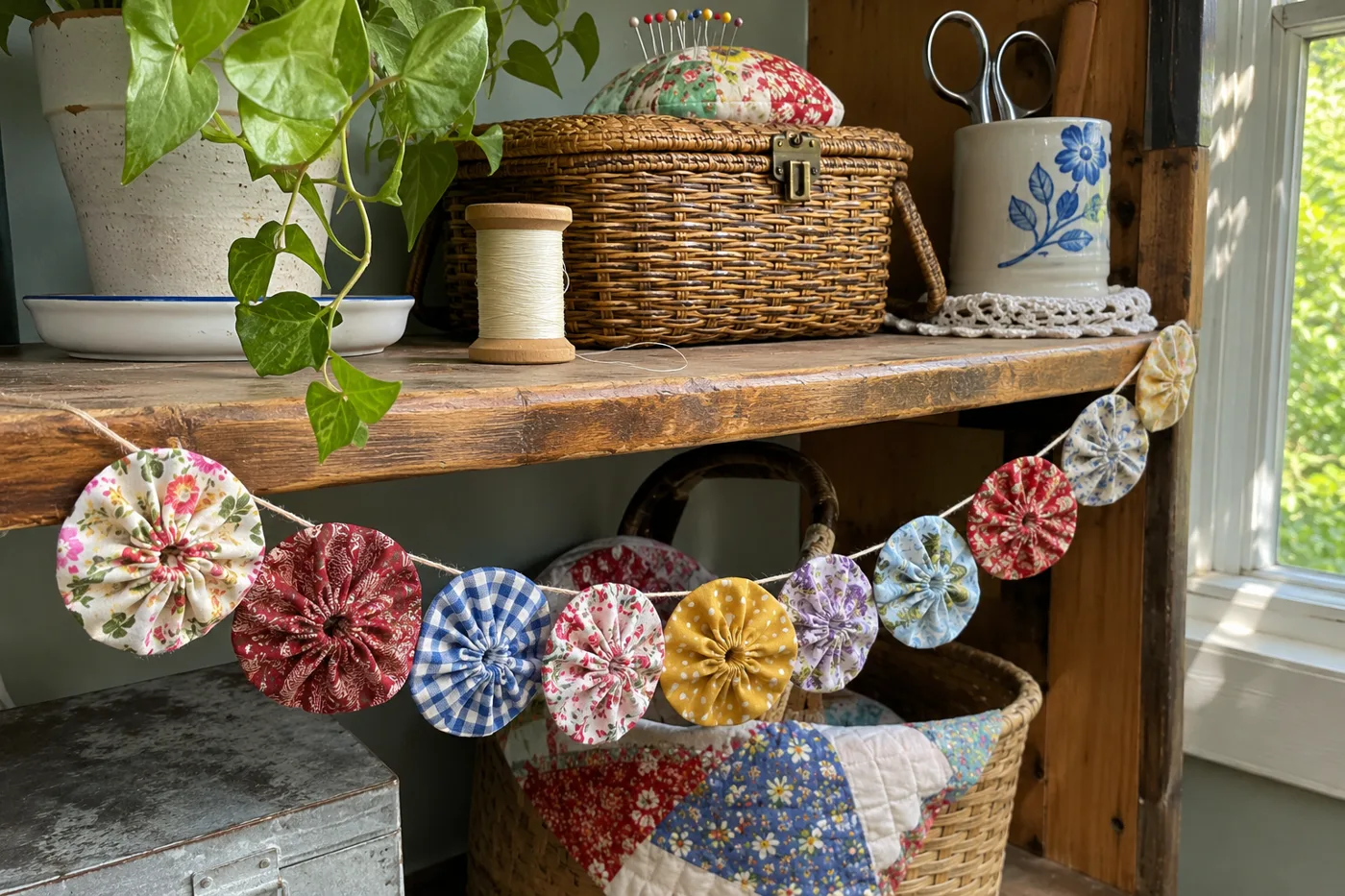
Cut a circle of fabric, sew a running stitch around the edge, pull the thread tight and press it flat. You’ve got a little puckered rosette. String enough of them together and you’ve got a garland made from every old dress and apron in the scrap bag.
They were already old by the 1960s. The Museum of the Rockies keeps a yo-yo quilt made around 1930 in Sioux City, Iowa, with circles 2¼ to 2½ inches across.
The circles themselves never went away. In Britain they’re Suffolk Puffs or Yorkshire Daisies. In Brazil, fuxico.
#7 A foil-covered cardboard star on top
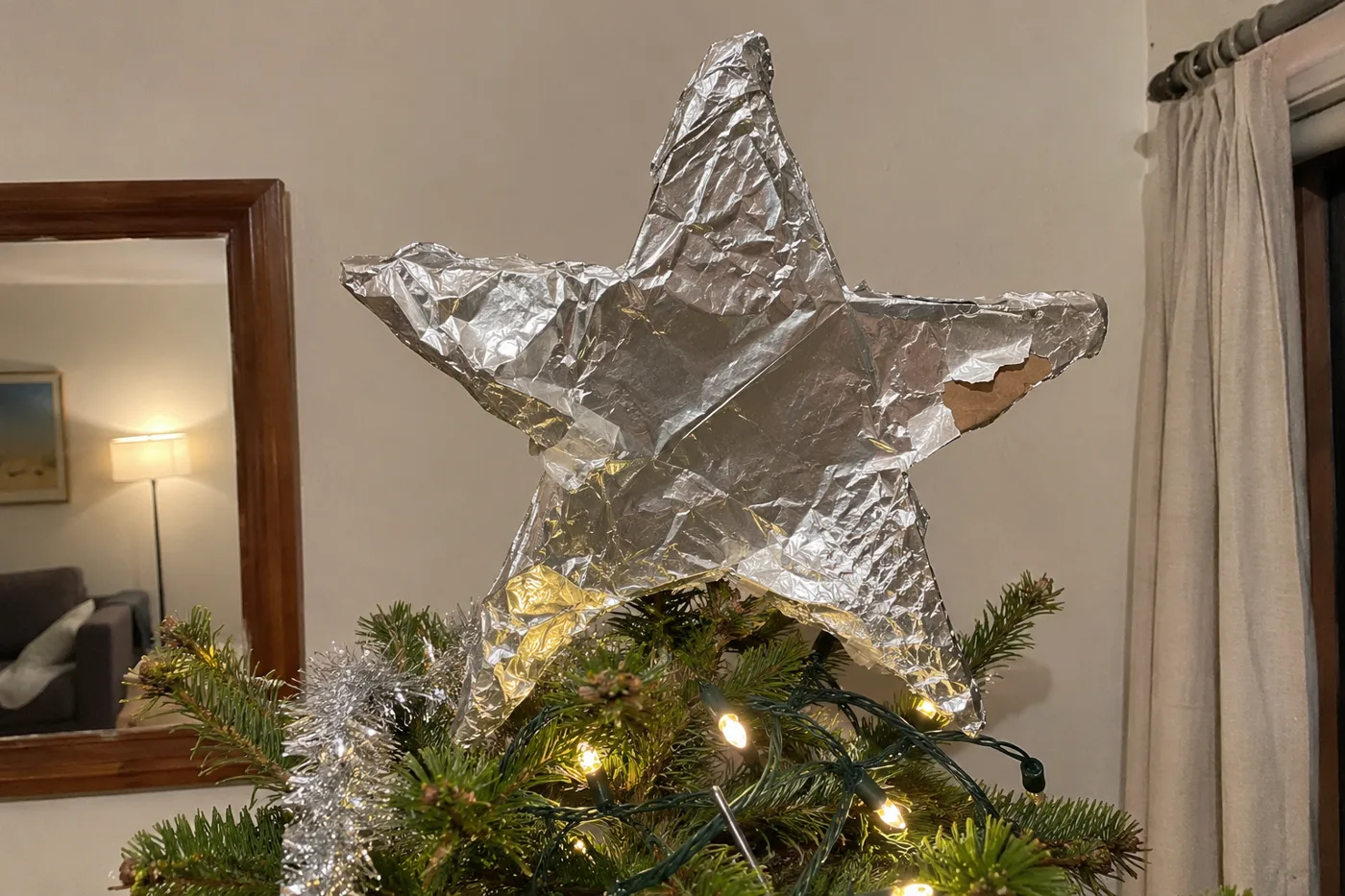
A star cut from the cardboard that came in a new shirt, wrapped in kitchen foil and taped to the top of the tree with more tape than anyone admitted to.
The foil is younger than it feels. Reynolds Wrap household foil arrived in 1947, decades after the cookie cutters it shared a drawer with.
#6 Paper doilies folded into window angels
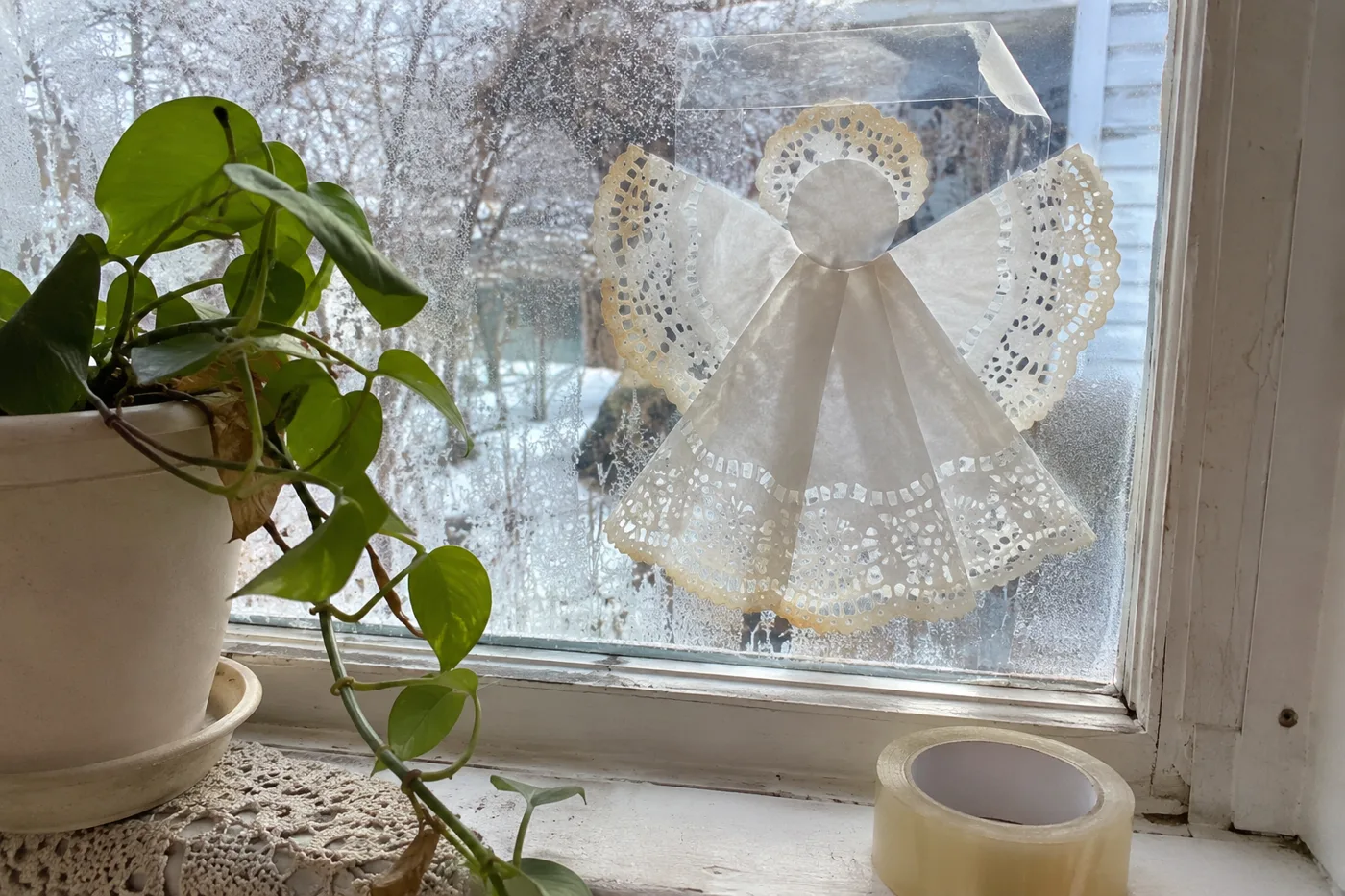
A round paper doily folded into a cone for the skirt, another cut for wings, a paper circle for a head. Taped to the front window, the angels caught the light like real lace.
Paper lace started as a mistake. In 1834, a man working on embossed paper filed off the raised part and found he’d made holes that looked like lace.
The doilies barely changed after that. Royal Lace in Fort Wayne, Indiana, still stamps them out with steel dies first cut in 1930. A 1963 newspaper story valued those dies at over $1 million.
So the doilies are still around for anyone who wants to fold an angel.
#5 Styrofoam balls covered in sequins and pins
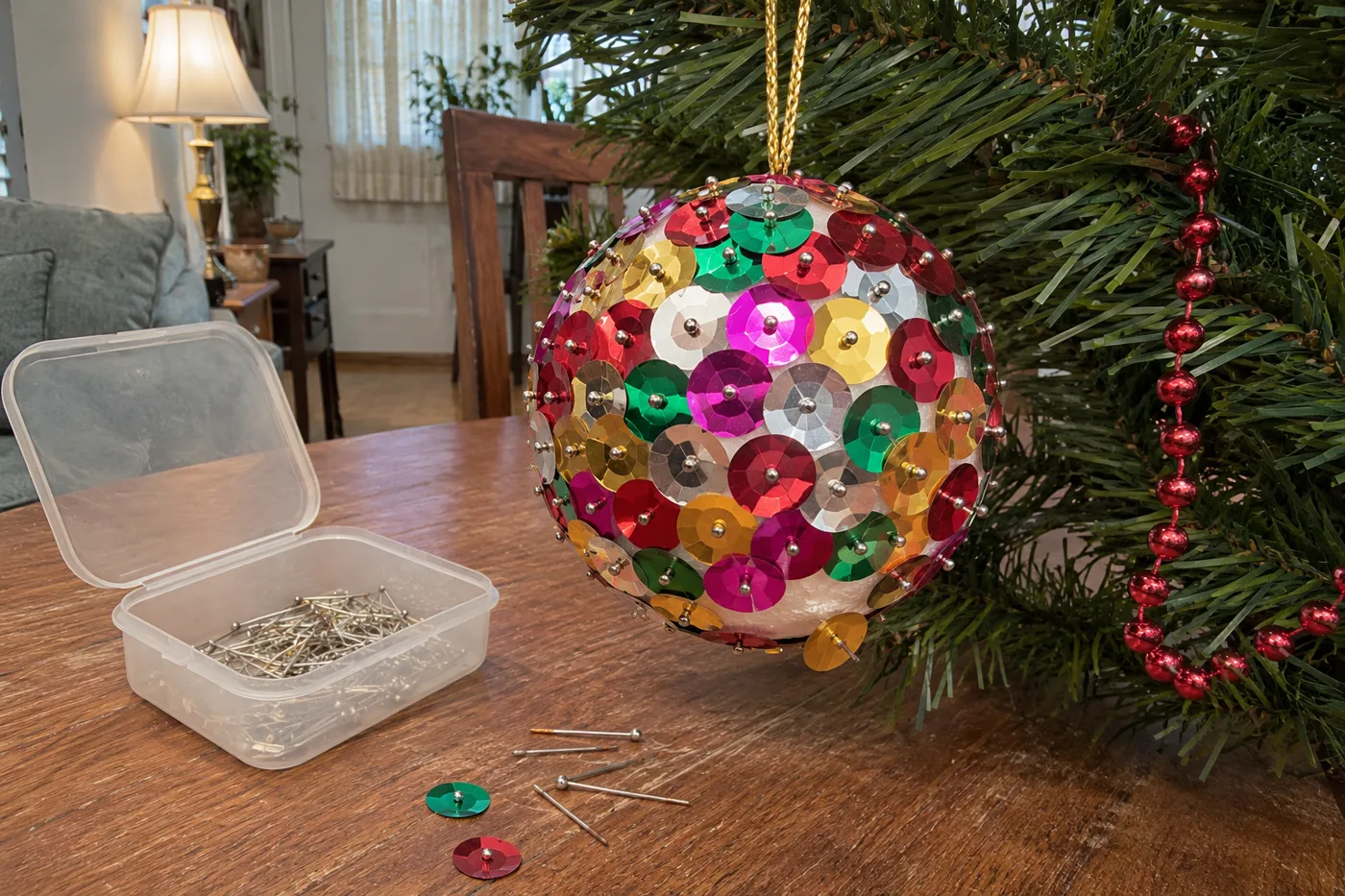
A Styrofoam ball, a box of straight pins and a heap of sequins. One pin through one sequin, pushed in, again and again, until the ball glittered or your thumb gave out.
The fancier version used sequins already strung on thread. A December 1964 Family Circle craft wound “sequins-by-the-yard” around foam balls with glue and pins, about 5 yards per medium ball. Beads, fake pearls and glass jewels came in packets at the dime store.
Good Housekeeping later put the same pin-and-sequin idea in a box, a beaded-fruit kit with the beads, sequins, pins and foam forms all included. Those original kits are no longer made.
#4 Glass Wax stencils frosting the window
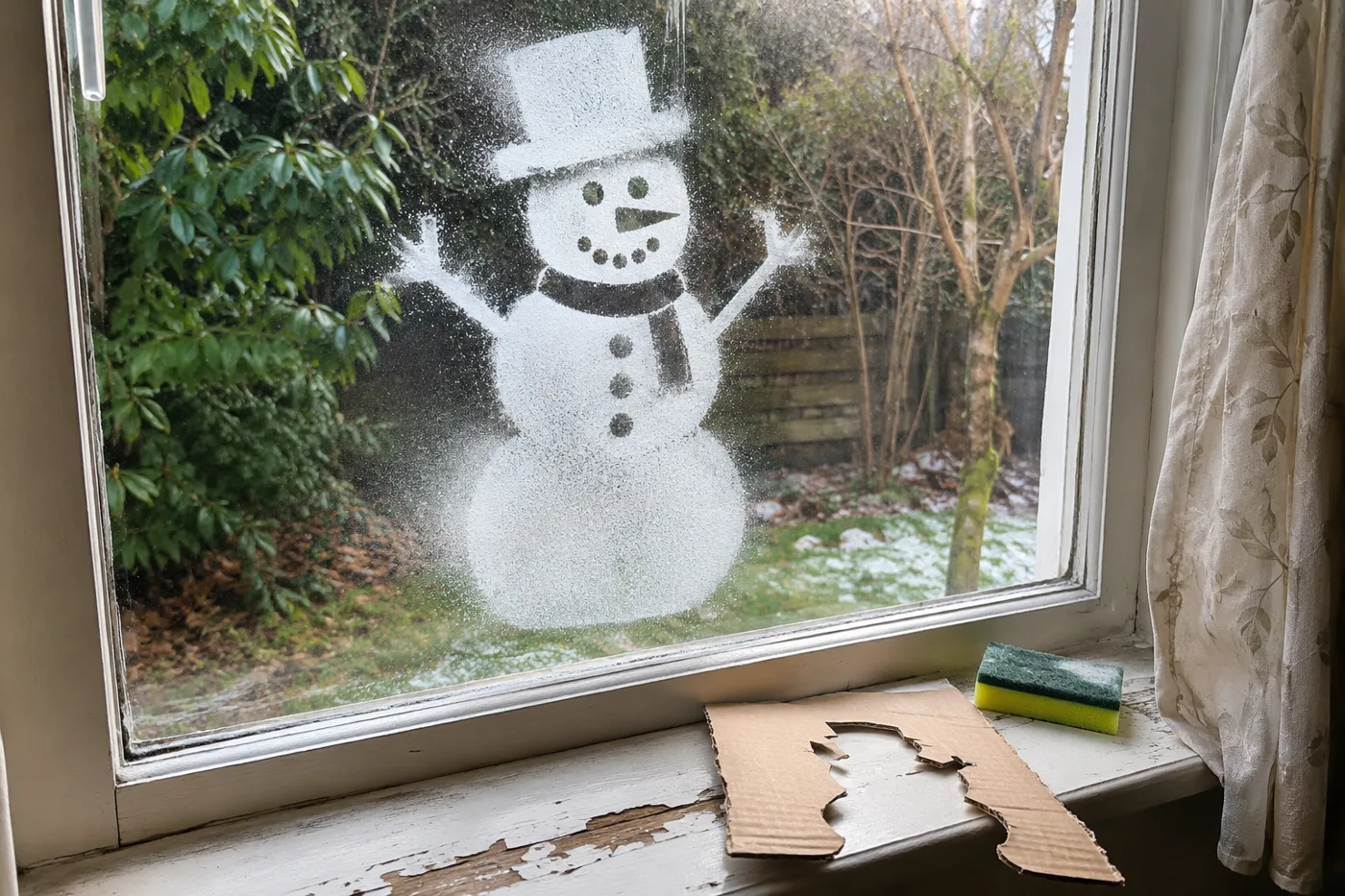
You taped a cardboard stencil to the window, dabbed Glass Wax through it with a sponge and peeled it away. Left on the glass was a white snowman, a wreath or a sleigh, frosty enough to pass for snow.
Glass Wax was a window cleaner from the Gold Seal Company of Bismarck, North Dakota. A schoolteacher wrote to the company president, Harold Schafer, that her students were drawing on the classroom windows with it. That gave him the idea.
The 23-stencil holiday set sold for 59 cents and was advertised on the Perry Como Show and the Mickey Mouse Club. It sold out by mid-December 1956. So Schafer went on Como’s show and asked Americans to share their stencils with the neighbors.
Come January, wiping the snowmen off cleaned the window.
#3 Sugar cookies hung on the tree
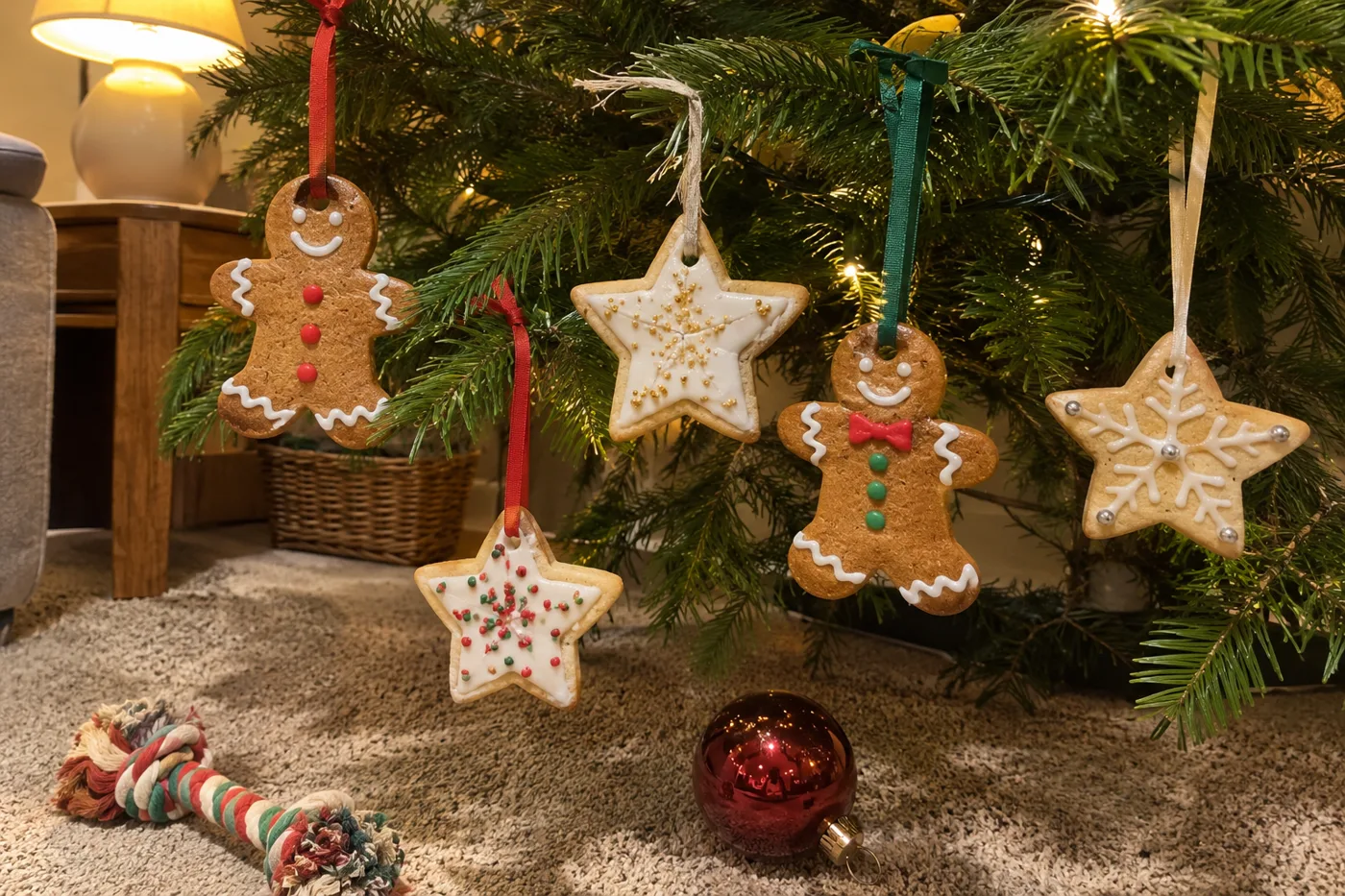
Cookies with a hole poked at the top before baking, a loop of ribbon, a coat of icing and a branch low enough for anybody to reach. In houses with a dog, the bottom row went first.
This one goes back to the 1800s. When cheap German cookie cutters flooded American stores between 1871 and 1906, hanging decorated cookies on the tree became an American habit, gingerbread men and animals included.
They’re still being made, and they were never meant to last. Nigella Lawson’s team says a decorated tree cookie lasts about a week, depending on the icing and the humidity, because it softens as it soaks up moisture. So hang them close to when you’ll be enjoying the tree, not right after Thanksgiving.
#2 Whipped Ivory Snow “snow” on the branches
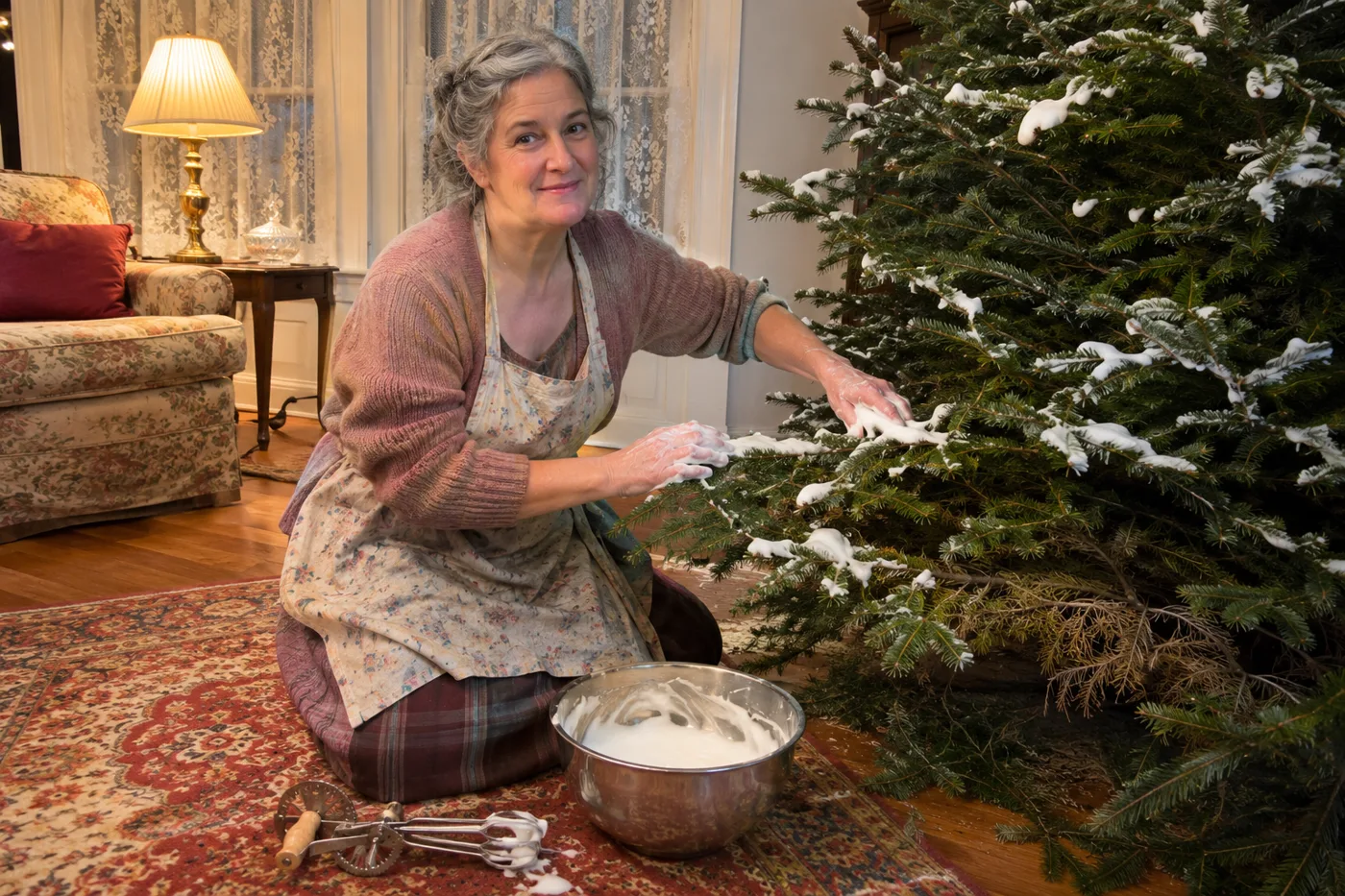
No snow outside? Somebody got out the box of Ivory Snow and the egg beater.
Soap flakes and a little water, beaten into a stiff white foam, then spread on the branches by hand.
Gary Long of Chambersburg, Pennsylvania, remembers a 1950s Scotch pine trimmed with red lights, red shiny balls and Ivory Snow flakes whipped and “layered on the branches to look like new-fallen snow.” The living room smelled like clean laundry.
Some families stirred in mica flakes for sparkle. A Waterville Historical Society writer whose family did this in the 1940s tried it again recently and could only find a granular Ivory Snow. It whipped up with an electric mixer, she reported, but it was “not as good as flakes.”
#1 The ceramic Christmas tree from class
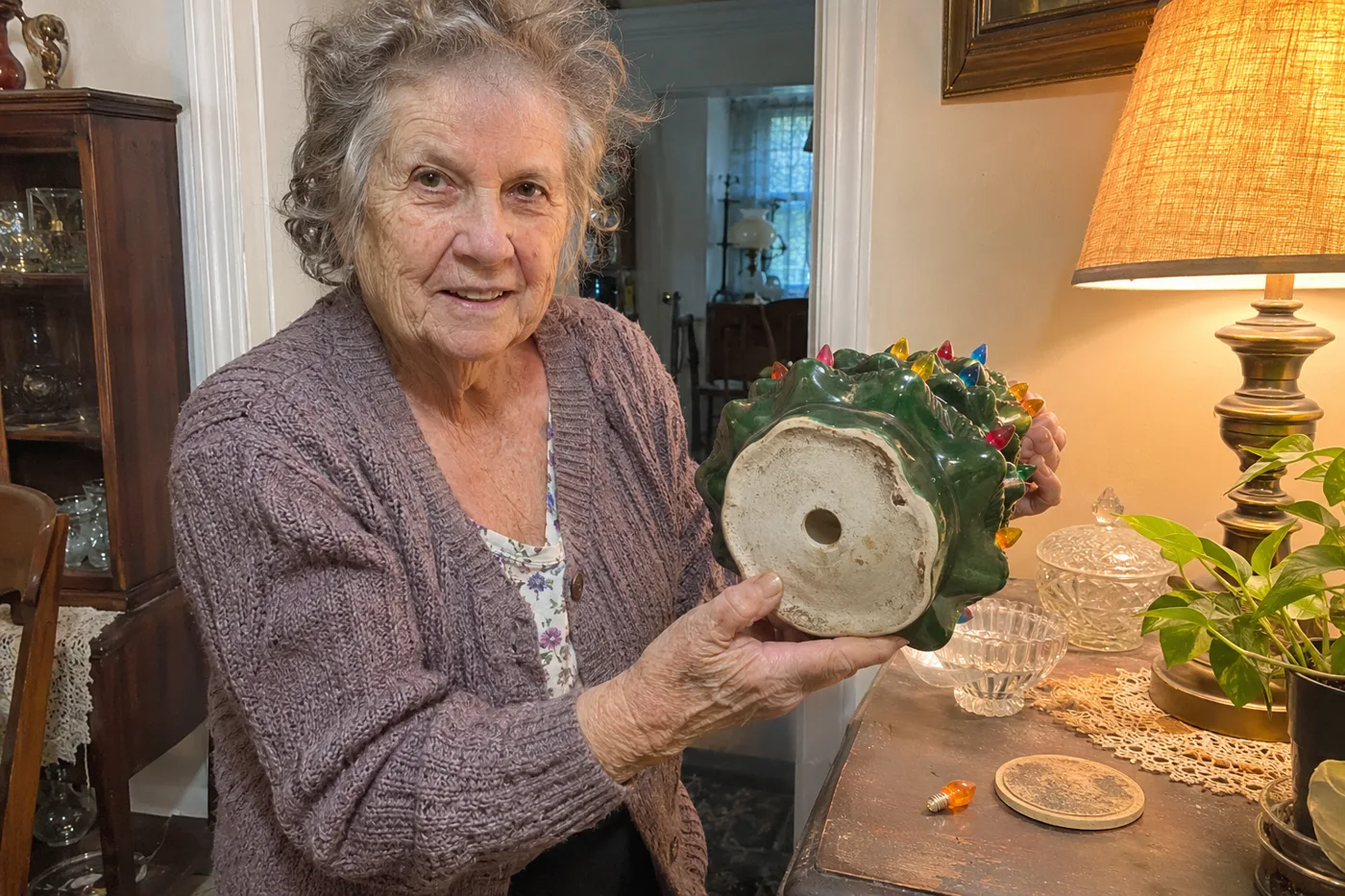
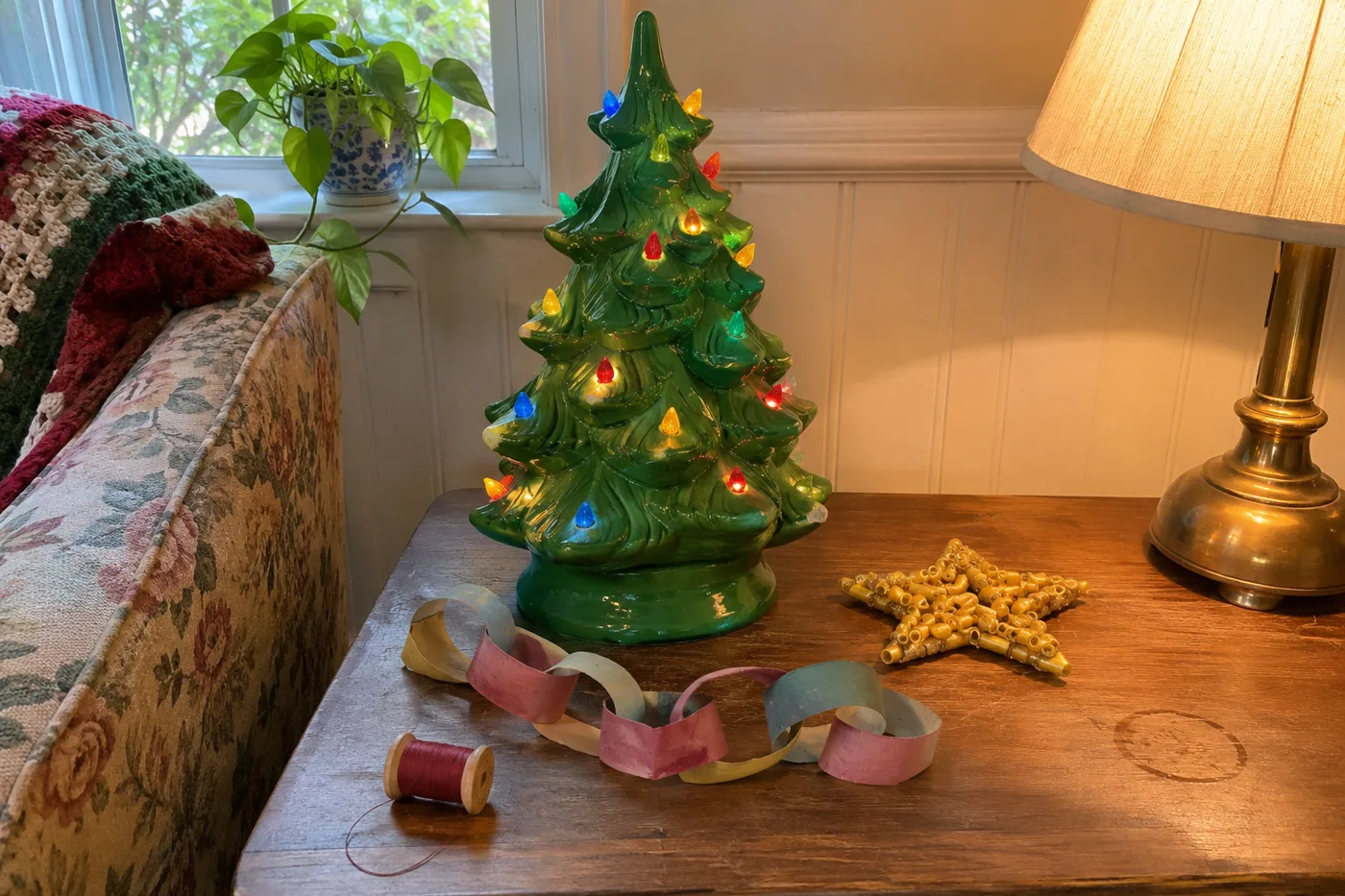
It sat on an end table and glowed: a green glazed tree with little plastic bulbs in red, yellow and blue pressed into holes, and one light inside that lit them all at once. Many people remember losing at least one bulb to the vacuum.
Not every family had one. The ones who did often made it in a ceramics class at a local craft shop, poured from a mold, sanded, glazed and fired. Those classes took off in the 1960s and 1970s.
The trees started falling out of favor in the 1980s, and once cheap ready-made ceramics from Japan and China arrived in the 1990s, they were mostly done.
Now turn one over, if it’s still around. The date on the bottom is almost always the year the mold was copyrighted, not the year the tree was made. A tree stamped 1958 may well have been glazed in 1972.
Reading the date on the bottom
- Ceramic trees first appeared in the 1940s, made one at a time by individual artists
- Atlantic Mold copyrighted one of the earliest designs, the A-64, in 1958, and sold thousands of those molds to studios across the country
- The year stamped on the base is usually the mold’s copyright year
- So the stamp dates the design, and the tree itself is probably younger
The bottom line
If you ever want to bring one back, start with whatever your house has too much of right now. Shipping boxes and takeout lids are this decade’s egg cartons.
And if somebody else sat at that kind of table with you, ask which one they remember best. It’s rarely the one you’d guess.
Bonus: Three ways to keep the survivors from disappearing too
- Before anything goes back in the box, write the year and the maker’s name, if you know them, on the back in pencil. Otherwise nobody may remember who made the macaroni star.
- Lay every homemade piece out on the table and take one photo of the whole spread. A picture keeps the set together even when the glue doesn’t.
- Back any fragile paper piece, like a saved napkin, a favorite scrap of wrapping paper or a drawing, with cardboard, and write the year on the back.
Questions people also ask
Can you still buy Ivory Snow flakes to make “snow” on a tree?
Maybe not in the old flake form. A Waterville Historical Society writer could only find a granular kind, which worked but wasn’t as good.
When did ceramic Christmas trees go out of style?
Their heyday was the 1960s and 1970s, thanks to craft-shop classes. They faded in the 1980s, and ready-made imports finished them off in the 1990s.
Why did people stop sending as many Christmas cards?
Mail volume collapsed, and nobody points to one single cause. Americans mailed about 2.9 billion holiday cards in 2002, dropping to only about 1.4 billion by 2014.
Is Minute Maid frozen orange juice concentrate being discontinued?
Yes. Coca-Cola said in 2026 that it was leaving the frozen can business, with the concentrates gone by April 2026 while supplies lasted.
Related posts:
19 Sewing Skills Your Mother Had That Nobody Has Now
26 Christmas Cookies From the 1960s That Nobody Bakes Anymore
23 Things People Over 60 Still Do When Decorating That Designers Beg Them to Stop
19 Holiday Traditions Women Over 60 Have Quietly Stopped Doing
23 Things Women Over 60 Keep Without Thinking That Professional Organizers Never Would
22 Things Home Economics Taught Girls in the 1960s That Schools Dropped

- 24 Things People Over 60 Still Do When Cleaning That Experts Beg Them to Stop - November 6, 2026
- 21 Handmade Gifts From the 1970s Your Grandchildren Have Never Seen - November 6, 2026
- 25 Homemade Christmas Decorations From the 1960s, and What Became of Each One - November 6, 2026

Leave a Reply