Hold on for #1: why the whole dish welded itself into one sweet brick, and the four simple ways to stop it.
The lid of the candy dish made a small glass clink every time somebody lifted it, and somebody was always lifting it. You knew every piece in there by sight: the folded ribbon, the soft striped mint, the red one with jam in the middle. What you never knew was what to call half of them. That 1960s Christmas candy did have names, and every piece has a story about where it went. Some are still sold. A few you can make with a pot and a thermometer.
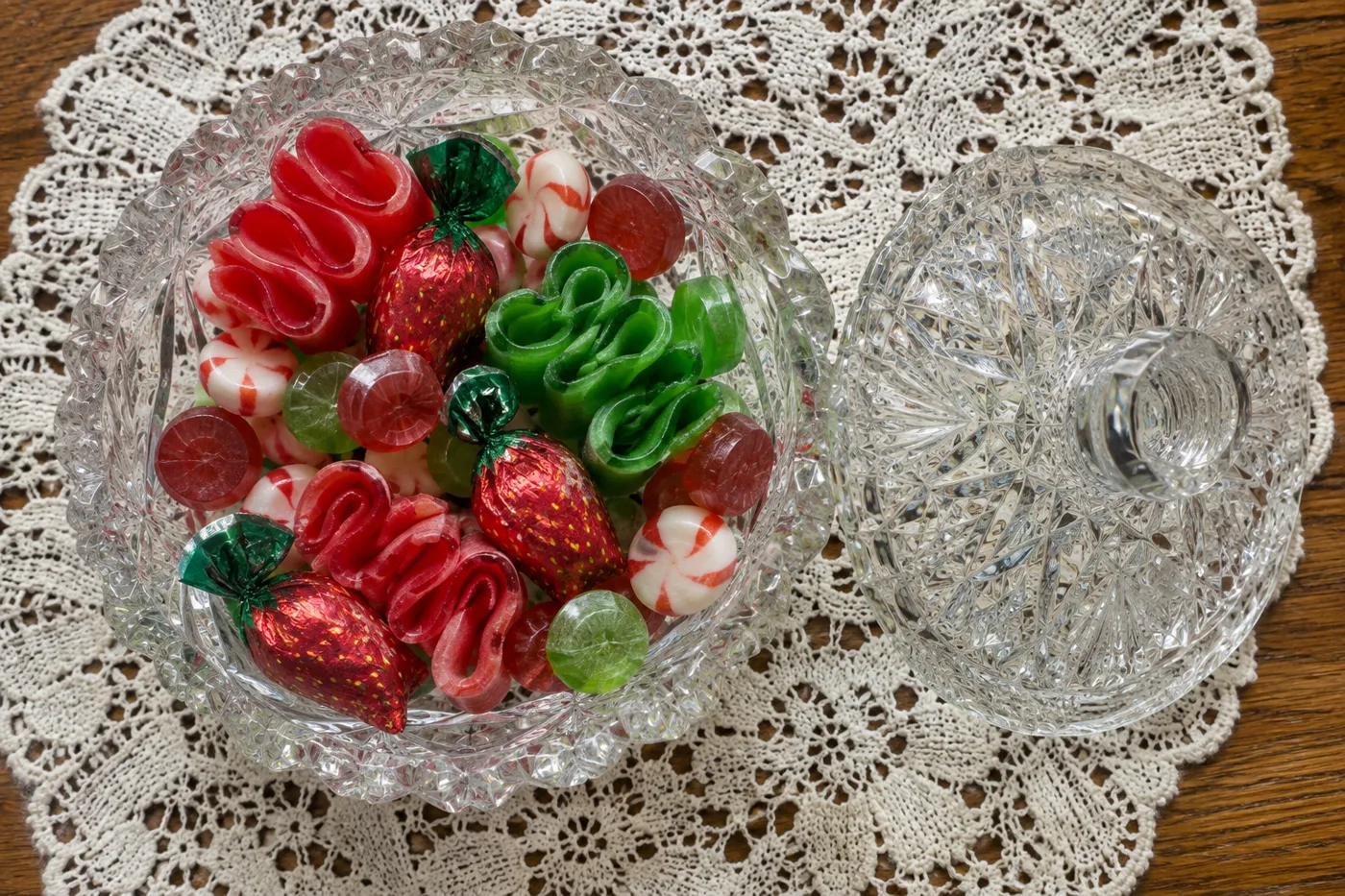
#17 Ribbon candy folded in the glass bowl
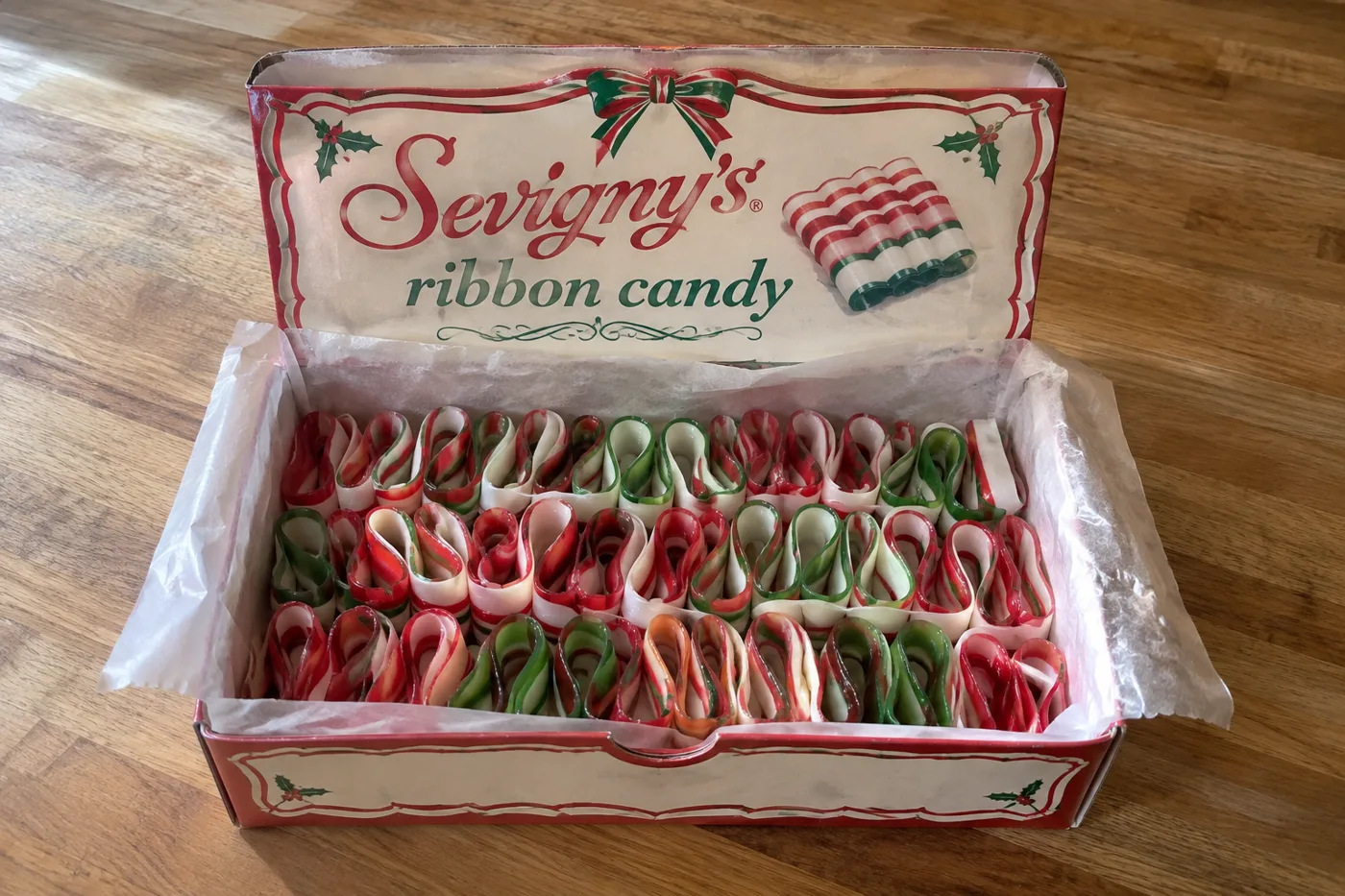
Ribbon candy is still sold, and the Sevigny’s name that sat on so many boxes is still on it. What’s inside the box is another matter.
For decades the big maker was F.B. Washburn Candy of Brockton, Massachusetts. It was founded in 1856 and calls itself “America’s oldest family-owned candy business.” Washburn bought rival Sevigny’s in 1986 and kept the name.
At full speed, the company turned out 400 pounds of ribbon candy an hour, 10 hours a day, four days a week, from March through Thanksgiving. It supplied Walmart, Russell Stover and Fannie Farmer. Then in summer 2019, the third-generation owners announced they were stopping. “It is time for us to pass the torch,” they said.
Sevigny’s boxes still turn up at Christmas. Between 2020 and 2023, buyers commenting under Yankee Magazine’s ribbon candy history said the newer candy is thicker and “doesn’t taste the same.” They said it uses fruit flavors instead of spice and mint, and that the box says Mexico.
That brings up the ribbon candy argument some families have every year.
A longtime ribbon candy eater on Reddit’s r/christmas remembers the childhood kind having a different flavor for each color.
The old box really did mix flavors. The traditional box held five: cinnamon, peppermint, wintergreen, orange and clove, with several colors and flavors in every box. If a new box tastes fruity instead of spicy, the box changed. You didn’t.
If you want the spicy kind back, Hammond’s Candies in Denver still spins ribbon candy by hand, in clove and cinnamon plus cherry and natural peppermint. There’s no wintergreen. A clove ribbon candy bundle, a four-pack of 3-ounce packages, is $35 online. For 2026, Christmas delivery means ordering by December 12 for ground shipping or December 19 for express.
It was also the candy everybody admired and fewer people finished. Ribbon candy shows up in nearly every Reddit thread about Grandma’s Christmas candy. Sometimes it’s somebody’s favorite, or a parent’s. Just as often it’s the piece that sat in the same dish year after year, gathering dust.
The 1962 Sears Christmas Book sold a “ribbon mix” on its hard candy page. If yours sat untouched until spring, it had a lot of company.
#16 Candy canes hung on the tree branches

People were hanging candy canes on trees long before anyone’s grandmother. An 1882 magazine already described “tall, twisted candy canes” on Christmas trees.
What changed just before the 1960s was the hook.
Robert McCormack started making canes in Albany, Georgia, in 1919. For years they were made by hand, and more than one in five broke along the way. That’s a lot of peppermint ending up as crumbs before it ever reached a tree.
The fix came from a Catholic priest in Little Rock. Father Gregory Keller built a machine to twist and cut stick candy in 1952. In 1957 he built the one that bends the hook.
“There was no such thing as the candy-cane industry…until the Keller Machine.” Bee McCormack, daughter of the company’s founder, via The Catholic Sun
So if your family hung canes on a 1960s tree, they were probably among the first generations of canes bent by a machine instead of a pair of hands. Father Keller gave all his royalties to charity.
#15 Chocolate-covered cherries in the gift box
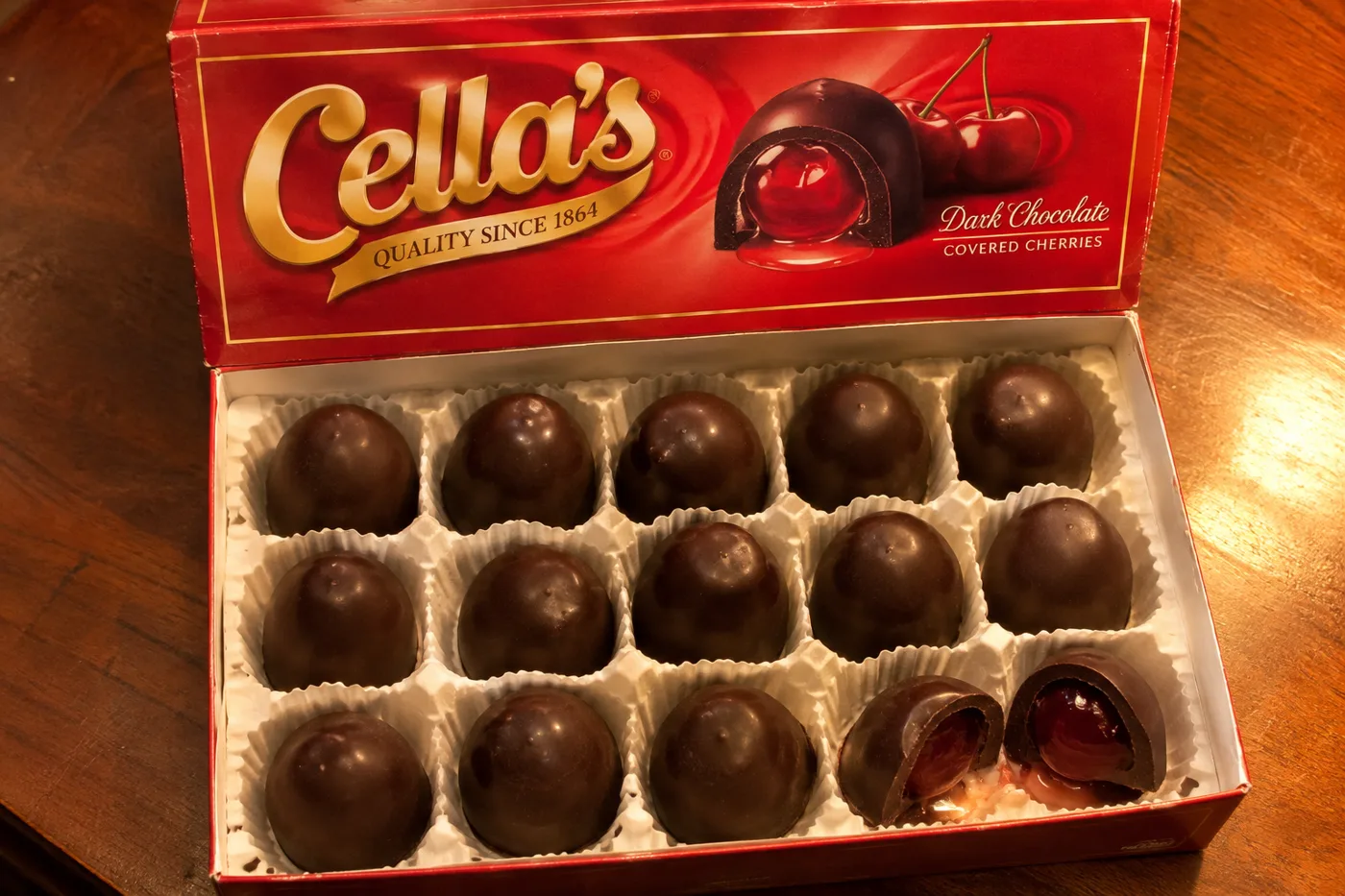
How does a candy cherry end up sloshing inside its chocolate? Give the box time.
The candy goes into its chocolate coat with a firm, sugary middle. After the chocolate is on, an enzyme called invertase breaks that sugar down from the inside. The whole thing needs up to two weeks of aging to go liquid.
So the cherry was quietly finishing itself inside the chocolate before the box ever reached you. That syrup that ran down your chin when you bit too fast was made inside a sealed shell.
French confectioners made cherries in chocolate with kirsch, called griottes, back in the 1700s. The American box plenty of people remember is Cella’s. Cella’s cherry cordials were introduced in 1864, went into big production in 1929, and have belonged to Tootsie Roll since 1985. They’re still sold.
Cherries also hid inside the fancier boxed chocolates. The Whitman’s Sampler came out in 1912 with an index printed under the lid. It was also the first candy to use cellophane. The shapes gave the fillings away: squares for caramels, ovals for fudge, and rounds for cherry cordials.
So if you always grabbed the round one, you weren’t guessing.
#14 Filled raspberry and strawberry candies
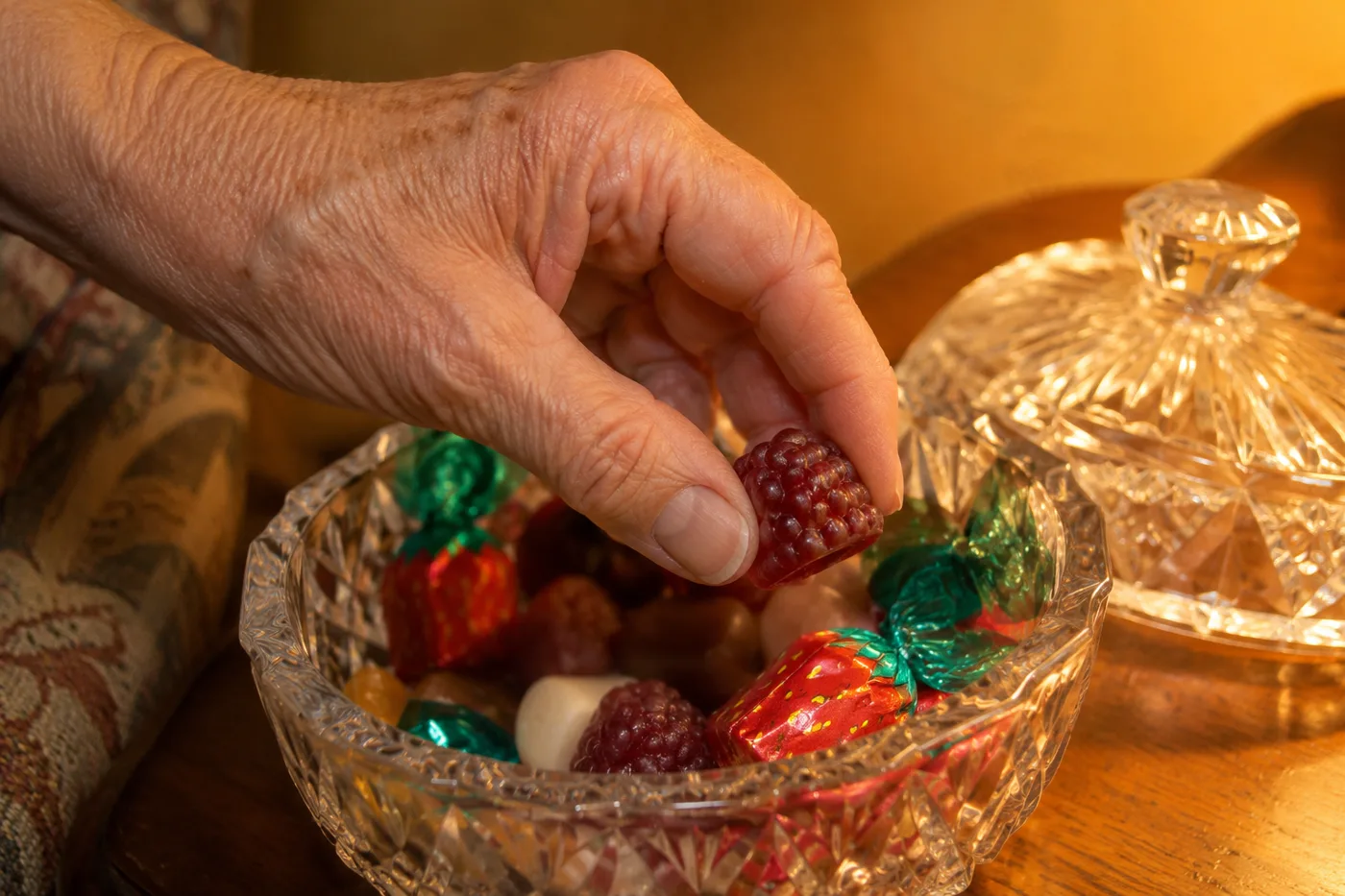
You dug past the butterscotch, past the ribbon, all the way to the bottom of the dish. The raspberries were gone. Somebody got there first.
In Reddit threads about the old Christmas mixes, the berry-shaped pieces with the soft, jammy center come up again and again. They’re the ones people hunted for, and the ones somebody had already picked out.
They have names, and you can still buy both.
| Candy | How to spot it | Who makes it now |
|---|---|---|
| Filled raspberry | Burgundy, shaped like a raspberry | Primrose, family-run since 1928 |
| Strawberry bon bon | Foil wrapper twisted tight at a green “stem” | Coastal Bay |
Primrose still makes the burgundy raspberries. In 2026, Harmons listed the 11-ounce bag of Christmas Classic Filled Raspberry at $5.49. It was out of stock the day we looked, so buy early in the season if you want some.
The strawberries were sold as “old-fashioned” candies around the late 1950s and ’60s, with a gooey center. Brach’s put strawberry-filled hard candy in its Party Mix, right alongside the peppermints, cinnamon discs, butterscotch discs and spearmints.
If you’re buying for someone who used to fight you for these, buy two bags.
#13 Life Savers Storybook under the tree
It was a book you couldn’t read and everybody wanted.
The Life Savers Sweet Storybook goes back to 1935. It opened like a real book, five rolls on each side, ten in all. In a Reddit thread and a TikTok where people swapped Christmas candy memories, it was the top comment in both.
Over the years the rolls inside included:
- Wint-o-green
- Butterscotch
- Peppermint
- Butter Rum
- Tropical Fruit, Strawberry and Wild Berry
Peppermint had a Christmas cousin, too. A 1948 ad promoted Stick-O-Pep, a Life Savers flavor inspired by candy canes.
The book changed slowly. Life Savers were made in Port Chester, New York, from 1920 to 1984. By 2010 they were made overseas, and the Storybook held eight rolls instead of ten.
That’s two rolls fewer, from a factory an ocean away.
 You might also like22 Things You’re Saving That Your Children Will Throw Away
#12 Brach’s candy scooped by the pound
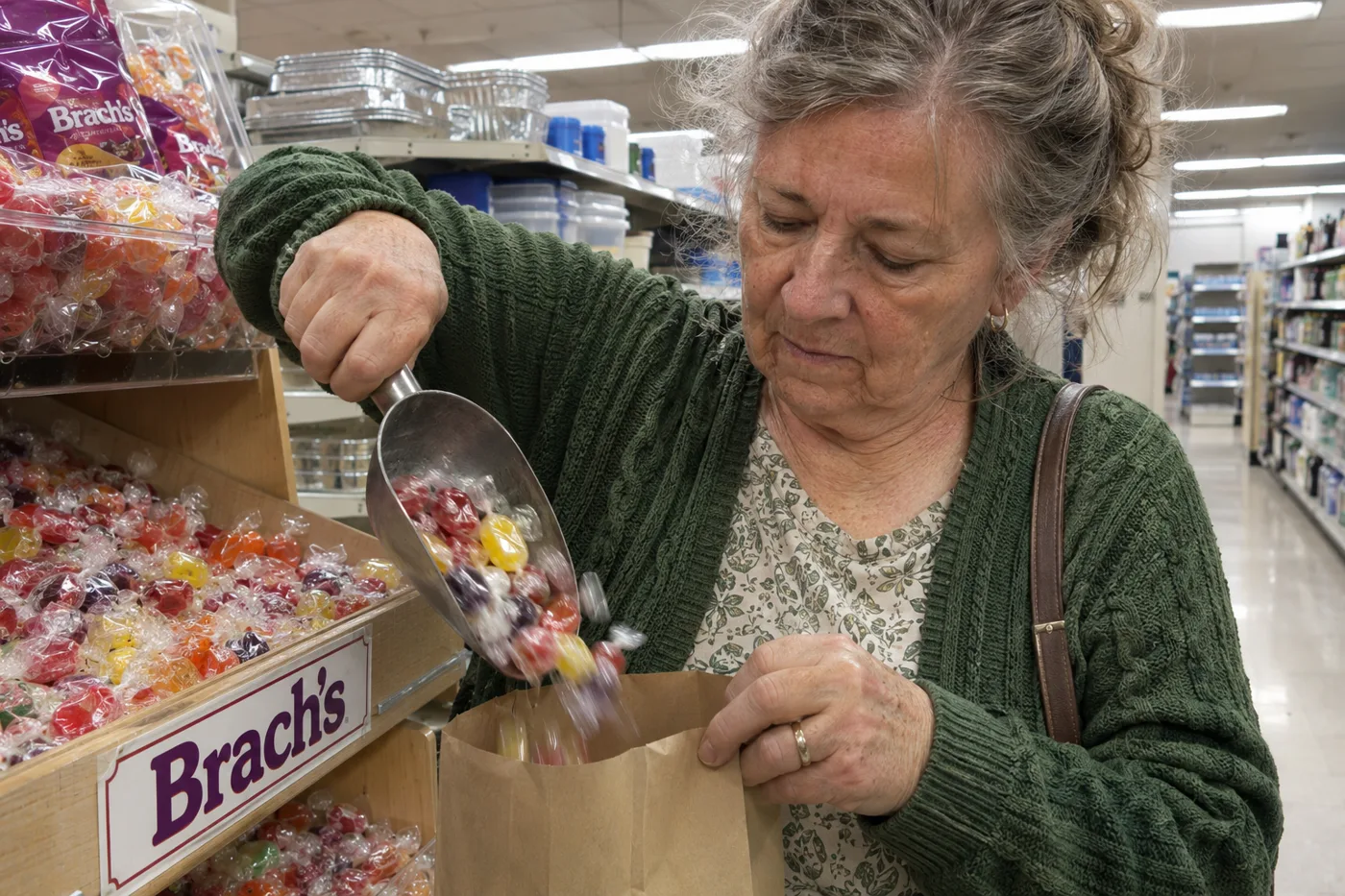
The scoop, the paper bag, the scale that wobbled before it settled. If you remember picking your own candy from a row of bins, Brach’s started that in 1958.
It was called Pick-A-Mix. Customers could choose from a wide selection, scoop it themselves and pay one price per pound. That’s how a lot of Christmas dishes got filled: a little of everything, rung up together.
Then the company changed hands, again and again:
- American Home Products, 1966
- Jacobs Suchard, 1987
- Barry Callebaut, 2003
- Farley’s & Sathers, 2007
The big Chicago plant was abandoned in 2003, and production moved mainly to Mexico.
Can you still find the old-style mixes? People in Reddit’s nostalgia threads say they do turn up at discount and variety stores in season. Others in the same threads ask where they’ve all gone. If a mix doesn’t taste like you remember, a lot has changed behind it: four owners and a new country.
Sugar by the pound, then and now
- In 1972, the earliest year on USDA’s chart, there were about 102 pounds of refined cane and beet sugar per American, almost 2 pounds a week
- By 2019 it was about 68 pounds a year, or about 21 ounces a week
- That’s about a third less refined sugar per person, by USDA’s estimate
- These figures count sugar delivered, not sugar eaten, and USDA links much of the drop to food makers switching to corn sweeteners
#11 Pecan log roll from the roadside store
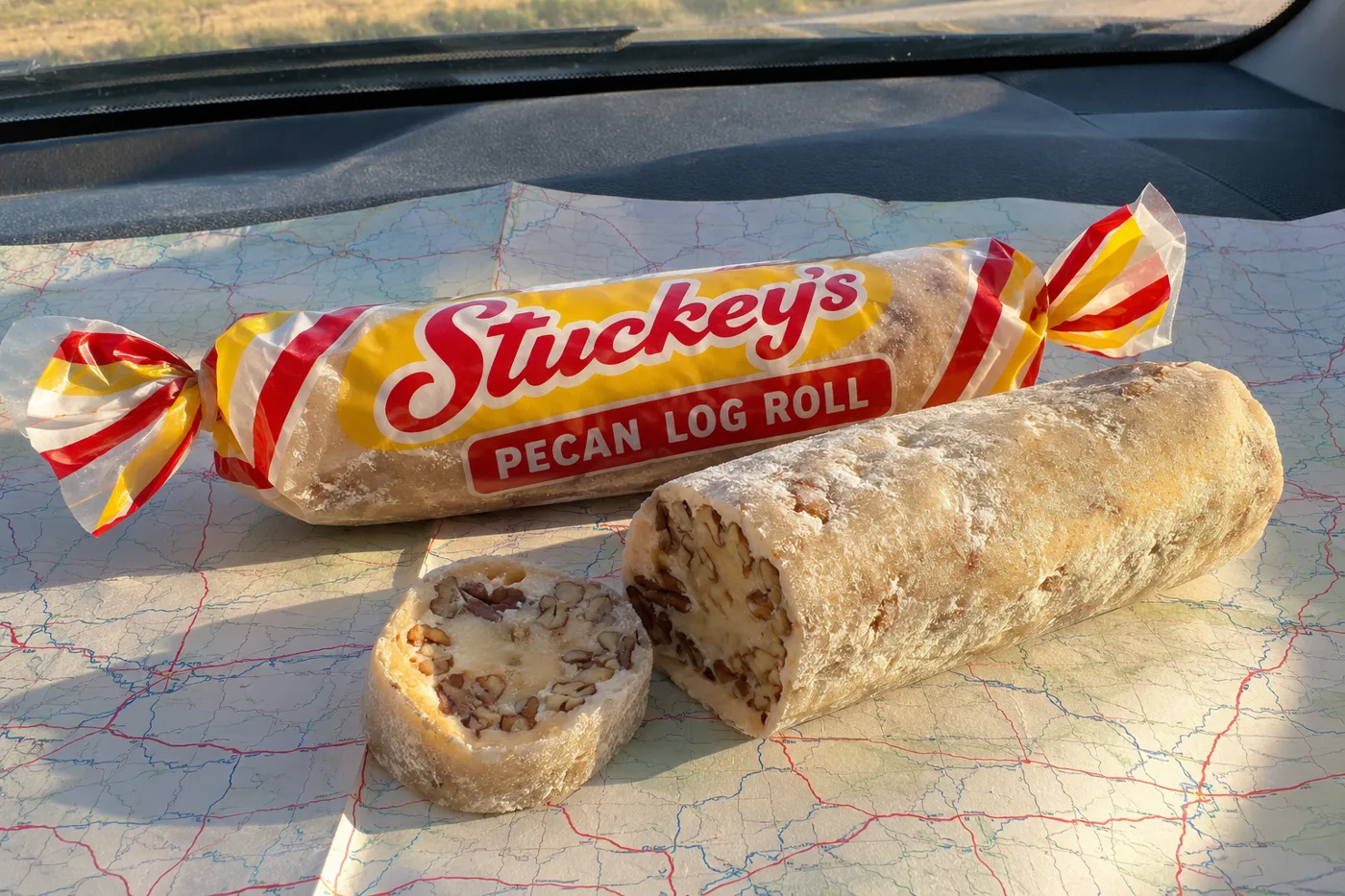
The car pulled off the highway, everybody piled out, and somebody came back with a pecan log in a wrapper. If your family ever drove long Southern highways, there’s a good chance it came from Stuckey’s.
It started small. In the 1930s, W.S. Stuckey Sr. sold pecans from a lean-to on Georgia Route 23 in Eastman. His wife, Ethel, sold her homemade pecan candies.
Her best seller was a roll made from powdered sugar, white molasses and roasted nuts. That’s the mystery center, solved.
That roadside stand grew to more than 350 stores. In 1967 it merged with Pet Milk, and the stores drifted away from the family for almost twenty years.
The family bought it back in 1985. In 2019 the founder’s granddaughter, Stephanie, took over. If you want the original, Stuckey’s is the name to look for. Its own shop sells the 1.6-ounce Pecan Log Roll by the dozen for $35.88, and orders arrive 3 to 8 business days after they ship.
#10 Haystacks of chow mein noodles and butterscotch
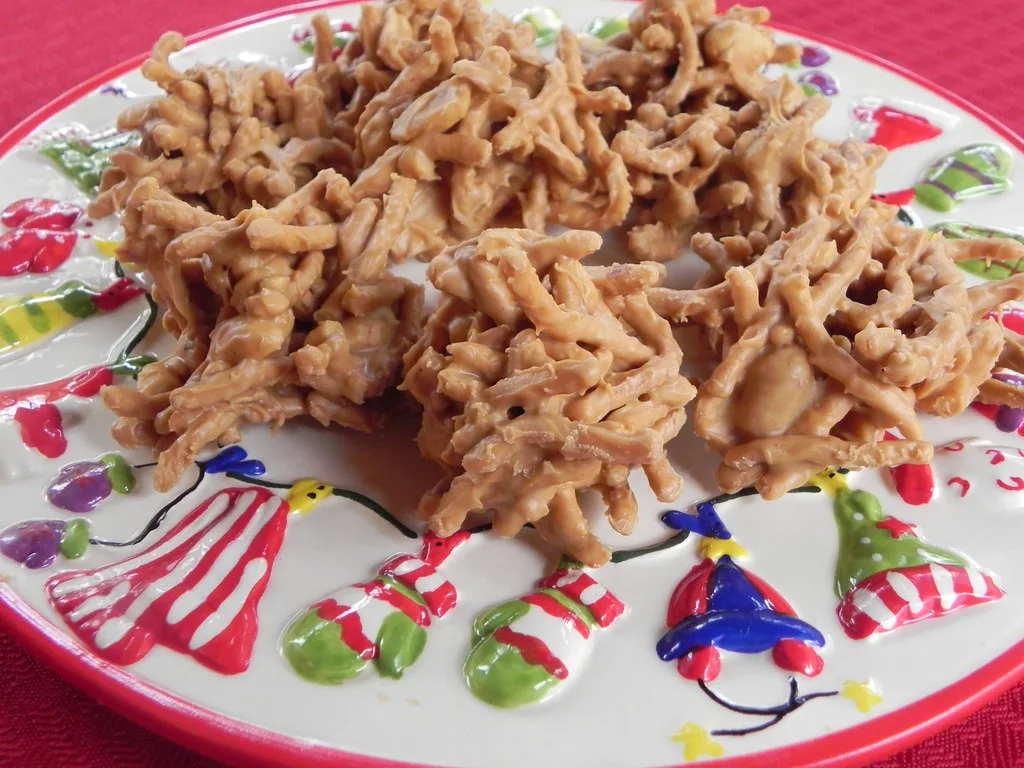
Cookie or candy? Haystacks never answered that. They sat in their little piles wherever there was room, and they were gone first.
They go back further than you’d guess. Kellogg’s printed a Corn Flakes Macaroons recipe on cereal boxes in 1932, and that started this whole family of no-bake sweets.
Betty Crocker’s 1963 cookbook is what popularized butterscotch haystacks. It used four things:
- Butterscotch chips
- Peanut butter
- Spanish peanuts
- Chow mein noodles
That’s the whole secret behind the crunchy little “straws” you could never quite identify as a kid. They were noodles from the Chinese food aisle.
This is the easiest candy here to make again. There’s no candy thermometer and no stages to watch for. You only need to melt the chips and stir everything together.
#9 Candy, orange and nuts loose in the stocking
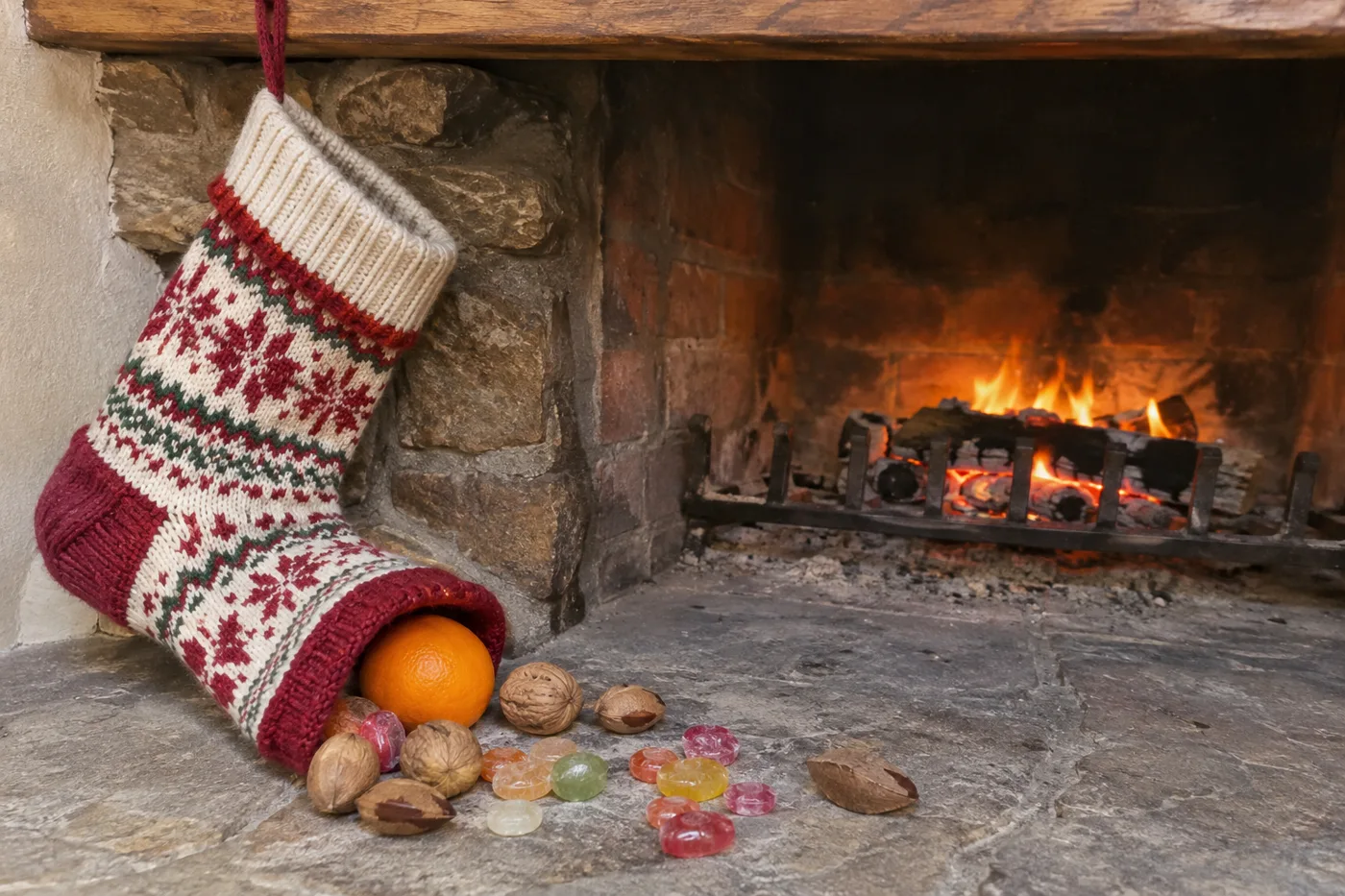
You reached all the way down into the toe and found it: an orange, round and cold, under the walnuts and the loose candy.
That candy came out wearing a little sweater of lint, because the pieces went in unwrapped. People on Reddit remember rinsing it off rather than losing a single piece.
Depending on where you grew up, there might have been an apple too. There were nuts in the shell, often a few Brazil nuts nobody could crack. The same Reddit threads remember a bowl of walnuts sitting near the candy dish, with picks and a nutcracker.
The orange is the oldest part of the tradition. It traces back to the story of St. Nicholas leaving gold for three daughters’ dowries. In 19th-century Europe, oranges were a luxury.
In America, Sunkist ads from the California Fruit Growers Exchange helped set the habit, and through the Depression an orange was still scarce and special. For Appalachian families in those years, writer Tim Carmichael says, an orange was “a rare gift that represented hope and a brighter future.”
So the orange that seemed a little plain next to the candy was the oldest thing in the stocking.
#8 Molasses taffy pulled with buttered hands
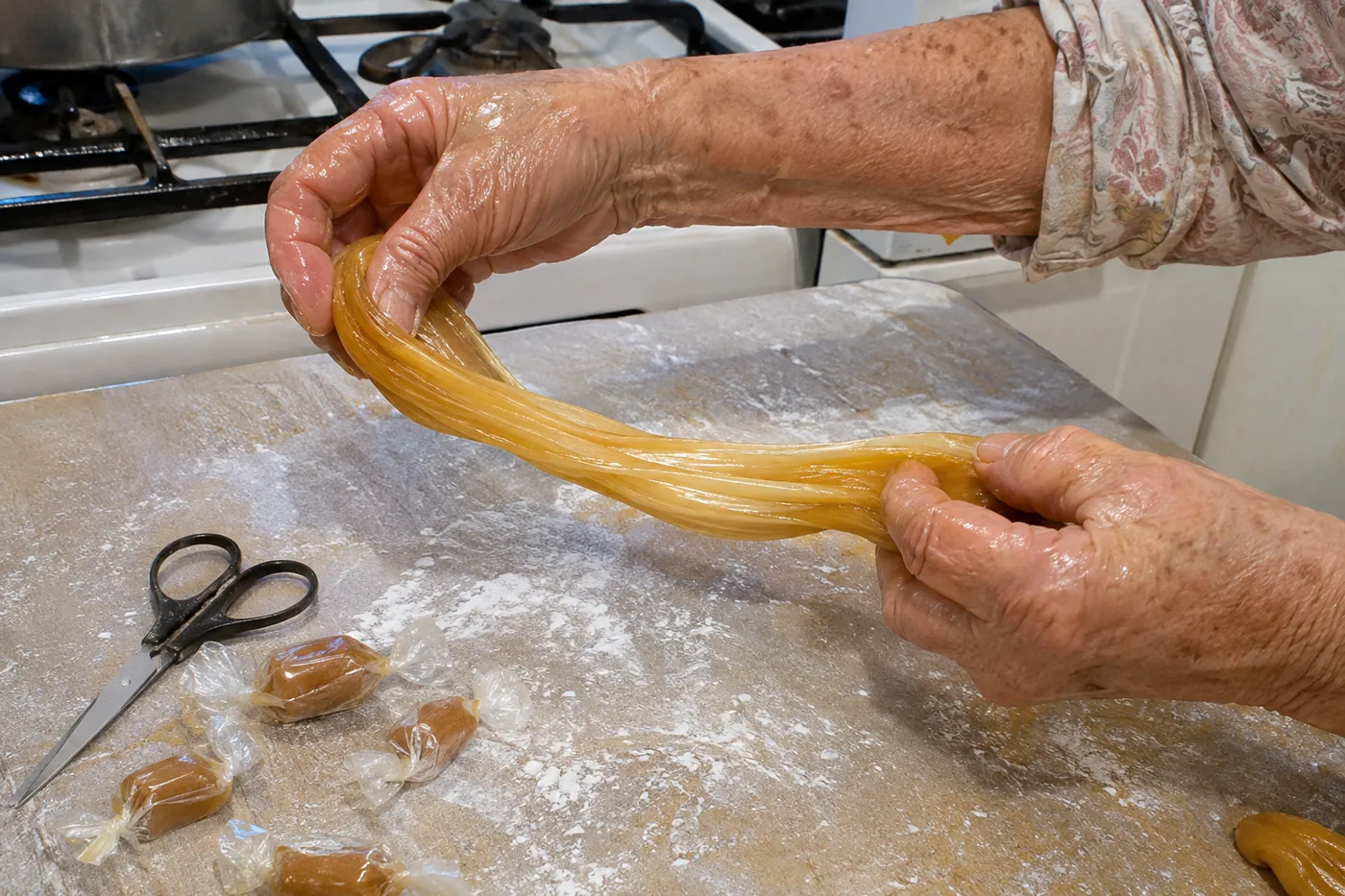
American Home magazine ran a recipe for “Golden Taffy Nuggets” in its 1960 Christmas candy feature. It reads like a set of stage directions.
The ingredients: ½ cup butter, 2 cups sugar, 1¼ cups light molasses and 1½ cups water. Here’s how the magazine had cooks do it:
- Cook the mixture until a drop forms a hard ball in cold water, or the candy thermometer reads 258°F.
- “Butter the hands slightly,” then pull the candy with the tips of the fingers until it turns light in color.
- Twist it into a rope about ¾ inch thick.
- Snip it into pieces with scissors and wrap each one in cellophane.
It made about 1½ pounds.
The cold-water test was the backup for homes without a thermometer. The color change is the good part. Dark, glossy molasses candy went in, and golden taffy came out of your hands.
The scissors were the other clever bit. They just go snip.
#7 Homemade fudge cooling in the pan
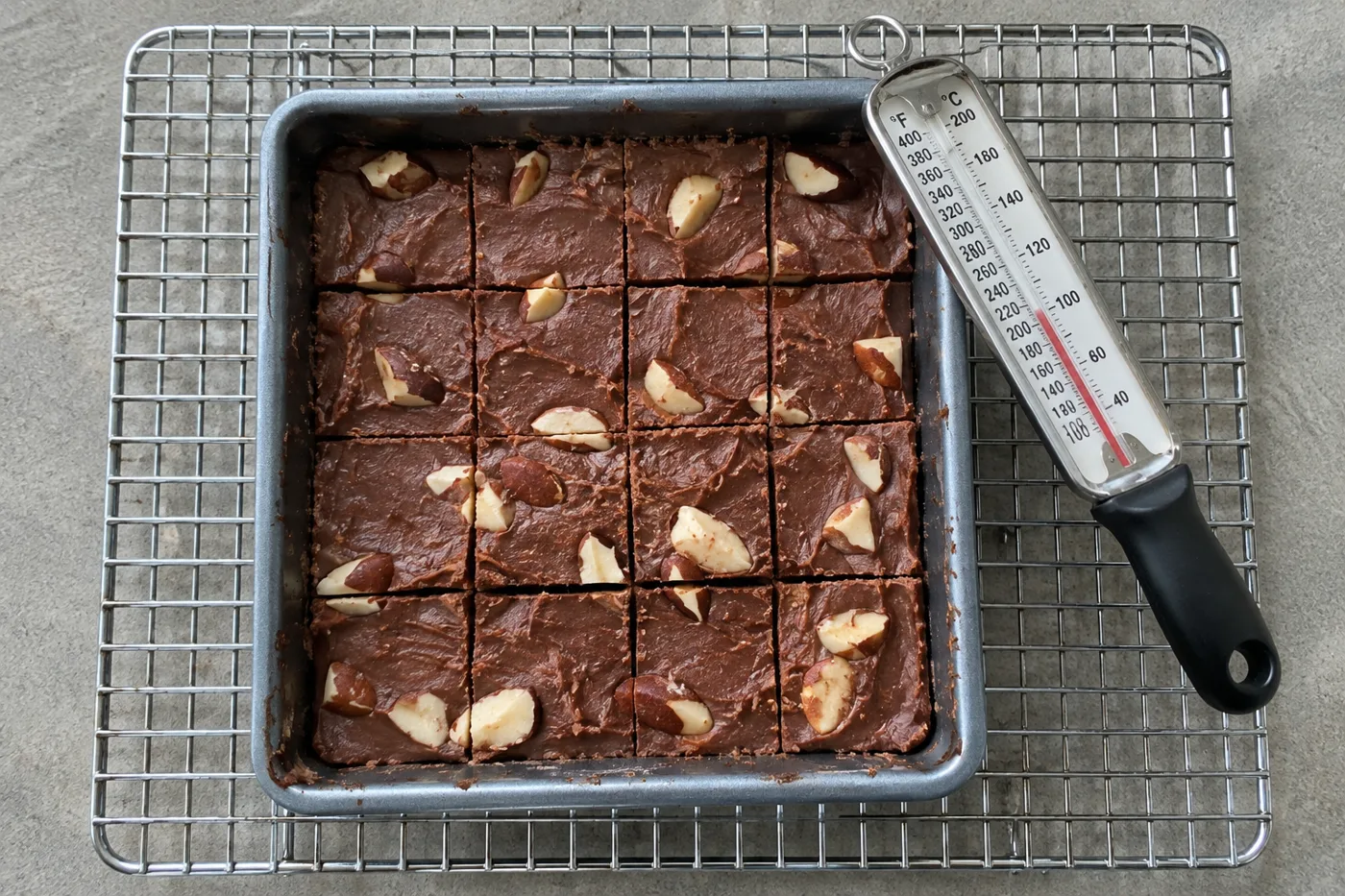
Fudge needs small sugar crystals to turn out creamy. The trick is to wait before you stir.
The hard part comes after cooking. Iowa State University Extension’s candy-making advice, AnswerLine, says to let the fudge cool to 110 to 113°F before you stir it. The stirring is what forms those small crystals.
The 1960 recipes knew the cooking temperature. American Home’s Christmas feature cooked its Chocolate Cream Fudge with Brazil nuts to 234°F, the soft-ball stage.
Here’s what most recipes leave out. If you live above sea level, lower the temperature by 2°F for every 1,000 feet.
- At 1,000 feet, a 234°F recipe becomes 232°F.
- At 5,000 feet, that’s 10 degrees lower: 224°F.
If your fudge has failed at altitude using a perfectly good family recipe, this is very likely why. The recipe was written for somewhere lower.
Fudge sat right alongside the other homemade pieces. When people on Reddit list what their mother or grandmother made at Christmas, it shows up next to divinity, candied walnuts, stuffed dates, pralines and bourbon balls.
 You might also like19 Holiday Traditions Women Over 60 Have Quietly Stopped Doing
#6 Peanut brittle cracked with a knife handle
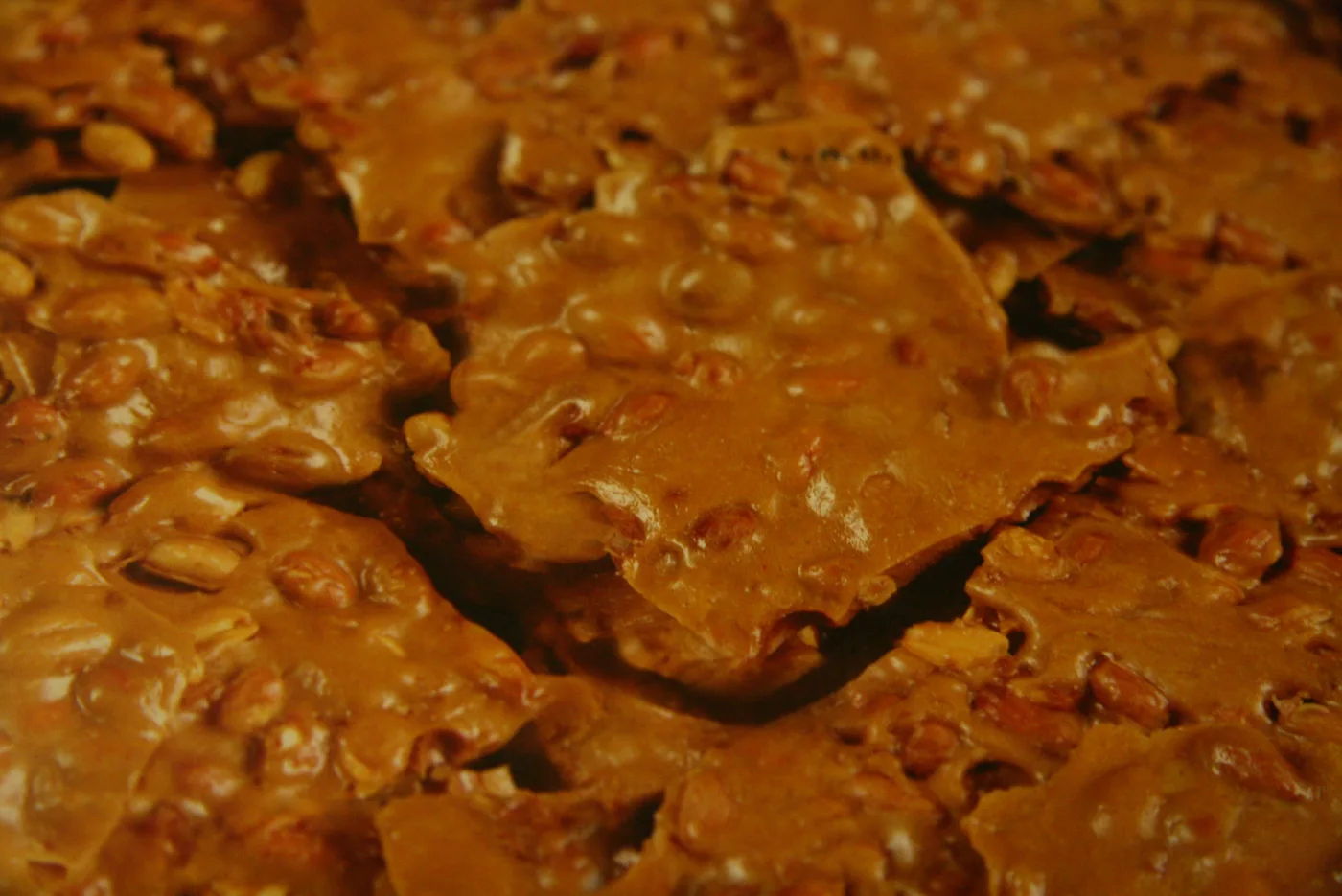
The slab came out of the pan in one golden sheet, and someone gave it a good whack with the back of a knife. Look closely at a broken piece and you’ll see it’s full of tiny holes.
Those holes are the whole trick. When baking soda goes into the hot syrup, the acid in the cooked sugar reacts with the alkaline baking soda to release bubbles of carbon dioxide, according to Alabama Cooperative Extension. Those trapped bubbles are what make brittle brittle. It snaps clean instead of bending.
The rest of the method, from the same extension guide:
- Cook the syrup to soft crack (270°F), then to hard crack (300°F)
- Corn syrup keeps the sugar from turning grainy again
- Let it cool 30 to 60 minutes before you break it
- Store it airtight
That foaming moment when the soda hits the pot always looked a little like kitchen magic. It was actually a small chemistry experiment.
#5 Clear toy candy shaped like Santas and animals
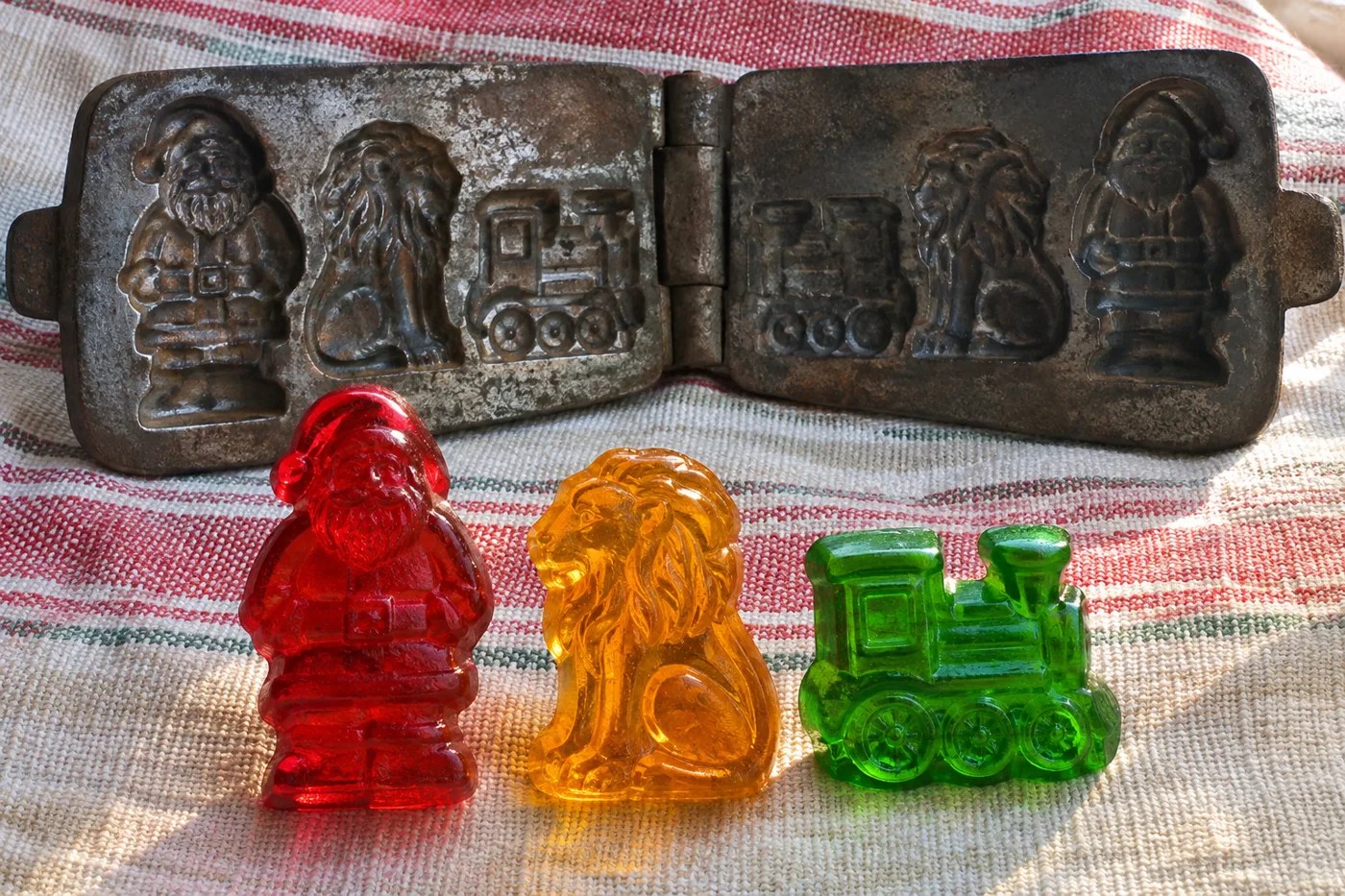
The see-through red Santa, the amber lion, the little green train you held up to the light. That’s called clear toy candy.
It came from Germany, where it was sometimes called “roter zuckerhase,” red sugar hare. German settlers carried it to Philadelphia.
It’s just sugar and water, with cream of tartar or corn syrup. Left alone, it cools a natural yellow. The reds and greens were added coloring.
Why is it so hard to find now? The molds. The first documented ones were patented in 1866, eight shapes including lions and trains. They were heavy, two-sided and cast from metal. The knowledge of how to make those molds disappeared with the craftspeople who made them.
Even the shops that still have old molds can’t keep up with them. Schimpff’s Confectionery in Jeffersonville, Indiana, has been making candy since 1891, and its shelves of molds are all for hard candy. The shop says on TikTok that it could use them all, but only has time for about six sets a year. Its flavors run from blackberry to watermelon, and each one gets its own color.
You can still buy it. Shane Confectionery in Philadelphia makes clear toy candy for Easter and Christmas.
If you spot an old mold at a flea market, display it and don’t use it. Some were made of lead or pewter, now known to be harmful for food contact.
#4 Cut rock candy with a picture inside

It’s called cut rock candy. That little cylinder with a flower or a tree inside, so tiny and perfect you turned it in your fingers, is still sold under that name.
People on Reddit describe it without knowing what to call it. The picture wasn’t printed or pressed in. It was built by hand, all the way through, like this:
- Colored cylinders of candy get stacked into the design, with white strips in between to keep the colors apart.
- The whole bundle gets wrapped in a thick white layer, then a mixed-color outer coat.
- That big log is stretched again and again until it’s thin.
- Once it cools, it gets chopped into slices.
The work happens on marble coated with edible beeswax, and the candy is pulled on hooks. That pulling traps air bubbles, which is where the shine comes from.
So the picture you saw was once the size of a whole log, shrunk down by stretching.
The British have a seaside cousin simply called rock, with letters running through it. The letters are built by shape, not alphabetically: “square” letters first, then “triangle,” then “round”. Morecambe made the first lettered rock in the 1830s.
#3 Divinity beaten on a dry day
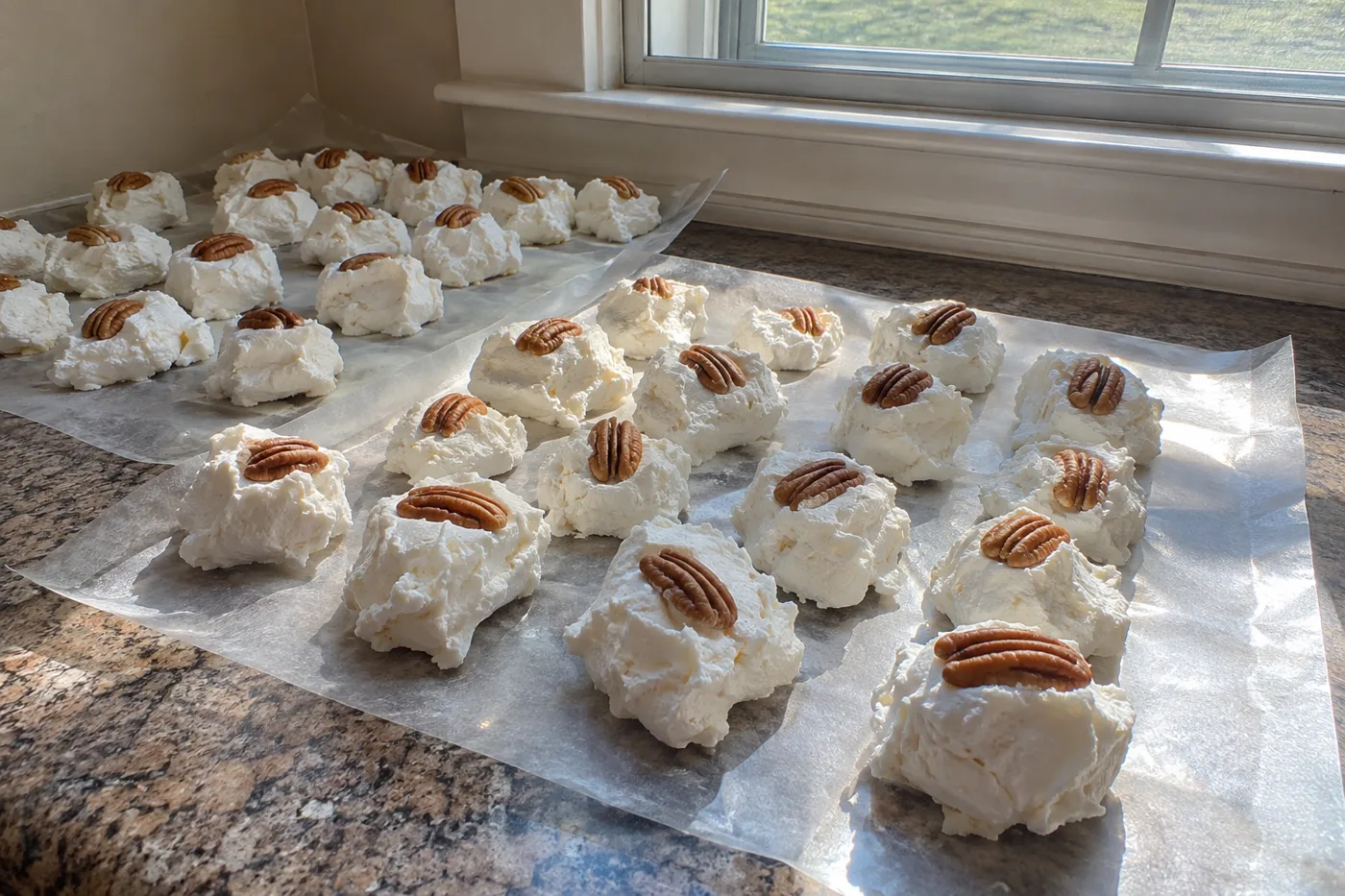
Plenty of cooks wouldn’t make divinity if rain was coming.
They were right. Divinity is cooked syrup beaten into whipped egg whites, and it’s cooked to about 250°F, the firm-ball stage.
On a humid day, the sugar absorbs moisture and stays sticky. The candy never sets into those snowy, dry-topped peaks. You get a sticky puddle and a long wait for nothing.
It’s a newer candy than it tastes. The earliest known recipes showed up in American cookbooks in the early 1900s.
If your weather won’t cooperate, you can still buy it. Jujube Divinity Candy, made with whipped egg whites, sugar and bits of jelly or nuts, is sold online.
#2 Bourbon balls on the cookie tray
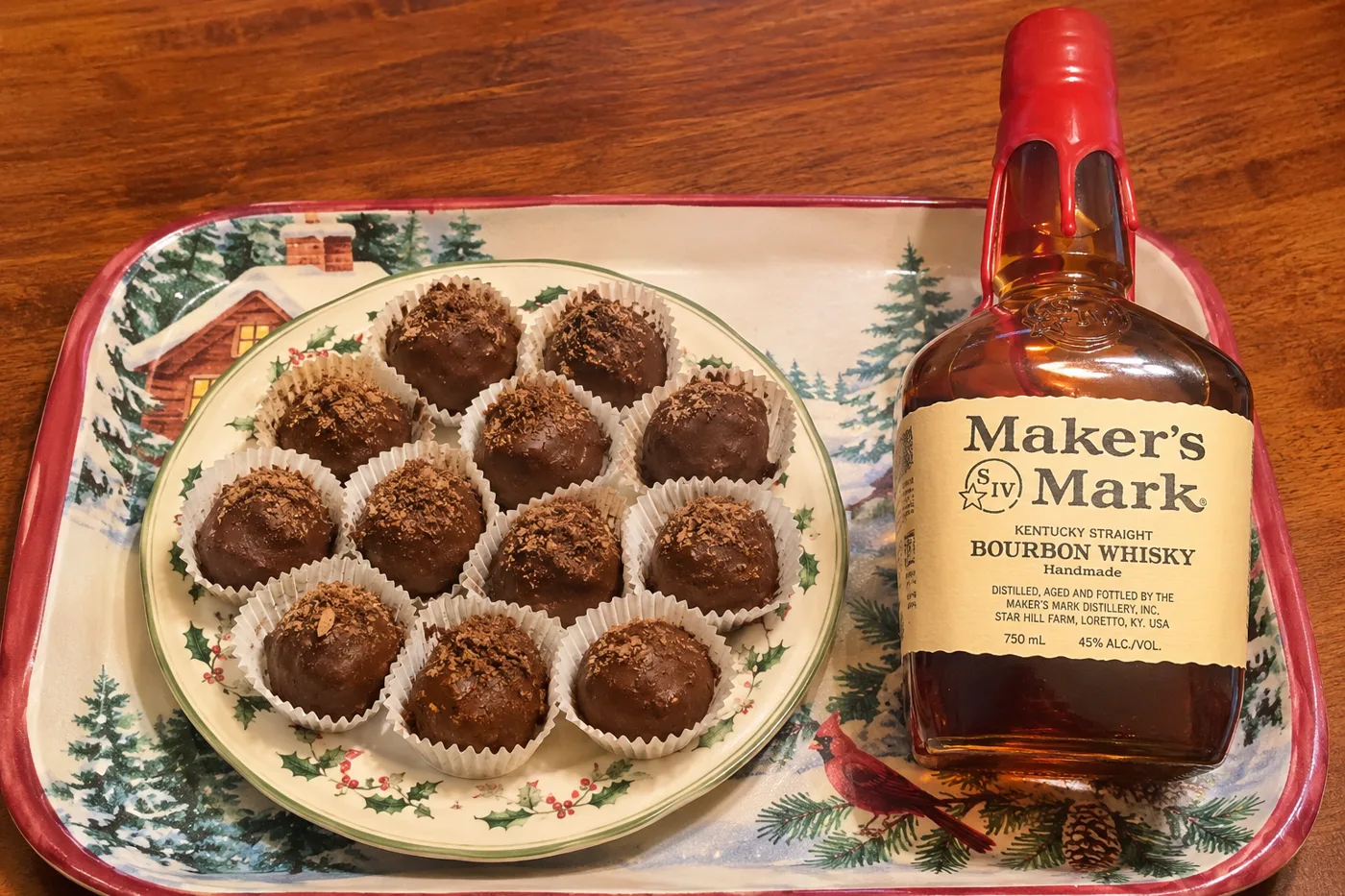
On Reddit’s r/GenerationJones, someone whose mother made the family’s Christmas candy said they loved her bourbon balls, but admitted that after learning to make them, they were surprised children were allowed to eat them.
That surprise is fair. Bourbon balls are never cooked once the liquor goes in, so most of the alcohol stays put.
A 1992 study measured how much alcohol stays in food after different cooking methods. Here’s what it found:
| How the alcohol was added | Alcohol left |
|---|---|
| Stirred in, no heat, stored overnight | About 70% |
| Flamed | About 75% |
| Baked 25 minutes, not stirred in | About 45% |
The study didn’t test bourbon balls themselves. But no-bake balls fit squarely in that first, no-heat group, and rum balls do too. So yes, the kids sneaking them were eating something that kept most of its bourbon.
If little ones will be near the tray, you might give the grown-up candy its own plate.
The bourbon ball itself has a sweet origin story. Two former substitute teachers, Ruth Hanly Booe and Rebecca Gooch, founded Rebecca Ruth Candies in Frankfort, Kentucky, in 1919. In 1936 a woman named Eleanor Hume Offutt “inadvertently inspired” their bourbon chocolates. In 1938, Ruth perfected the Bourbon Ball.
Ruth retired in 1964. Her family is still making them, four generations on.
#1 The lump that swallowed the whole candy dish
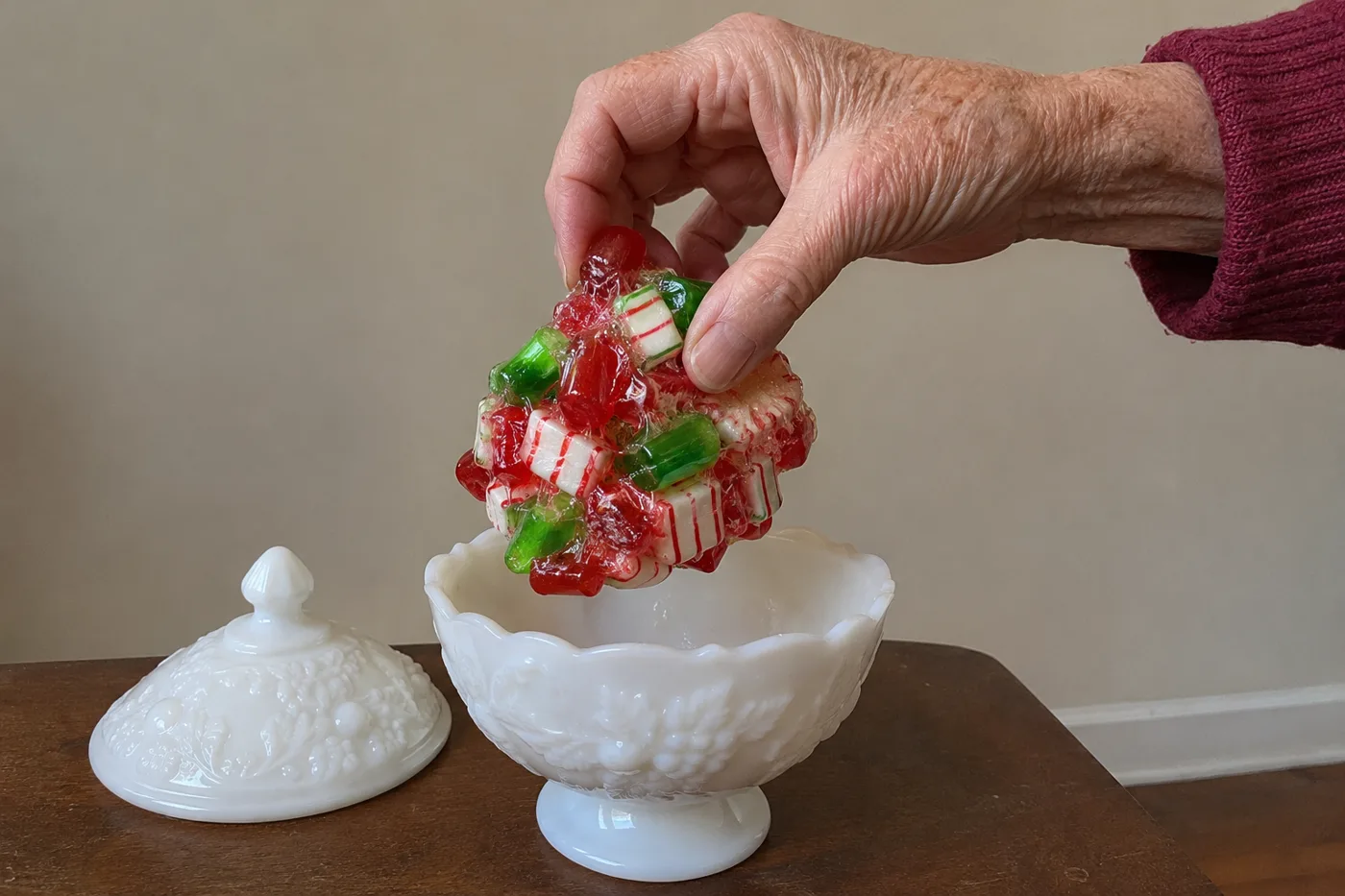
You reached in for one piece of hard Christmas candy, and the whole pile came up with it. In Reddit threads, people joke that the family candy dish needed a jackhammer to break it apart.
Someone on Reddit’s r/1970s remembers that when nobody ate from the dish, it turned into one solid lump in a month or two.
Here’s what was happening. Well-made hard candy is a dense, glassy sugar that water has a hard time moving through. But once it has cooled, the Exploratorium’s science of cooking site explains, on a humid day “it can actually start reabsorbing moisture from the air.”
The surface goes soft and tacky, and every piece touching it sticks. Days of that, in a dish with the lid on and off all season, and you had a brick.
There was a culprit in the mix, too. Candy with softer fillings is more prone to losing or gaining water, which makes it stick faster than the all-hard pieces.
The wrapped pieces had it easier. Iowa State University Extension says to wrap cooled candy to keep moisture out. So if you want a dish that can sit out all season, fill it with wrapped candy and keep the bare pieces stored away.
If you’re making hard candy yourself, Iowa State’s hard crack stage is 300 to 310°F.
How to keep hard candy from fusing together
- Dust each piece lightly with powdered sugar on both sides
- Store it in an airtight container, layered between sheets of waxed paper
- Keep it in a cool, dry place, and never in the refrigerator (LorAnn Oils puts it flatly: “Do not refrigerate.”)
- Making your own on a humid day? Cook it 2°F higher than the recipe says
Keep reading
 26 Christmas Cookies From the 1960s That Nobody Bakes AnymoreSee all 26 →
More you’ll enjoy
 26 Things Grandchildren Remember About Your House That You Never Notice
 25 Church Bazaar Crafts Every Town Sold That Nobody Makes Anymore
 24 Crafts Every Woman Made in the 1970s That Nobody Does Anymore
The bottom line
Grandma’s dish was never one kind of candy. It was a catalog page, a scoop from a bin, a book of rolls under the tree, a stop on a long drive, and whatever came off the stove that week, all under one glass lid.
Most of it can still be found or made. What vanished mostly went with the molds, the hands that folded it, or the owners who sold it.
So which piece did you dig for first? Find that one, buy it wrapped, set it in the dish, and put the lid on.
Bonus: Five more things to know, from the dish and beyond
- The soft striped mints that melt instead of crunch are Red Bird Peppermint Puffs, made by Piedmont Candy Co. since 1890. In 2026 Candy Nation listed them at $6.95, about 65 to a pound.
- Spice drops are among the oldest gumdrops, once flavored with clove, anise, allspice, spearmint, cinnamon and wintergreen. Zachary Christmas Spice Gum Drops in cinnamon and spearmint are still sold.
- Before you make an old orange-slice recipe, check the bag size. A 1953 Woman’s Day bar recipe called for a 16-ounce bag, and today’s standard bag is 10 ounces, so buy two and measure out 16.
- The torrone that came in little boxes still ships nationwide from Ferrara Bakery in Manhattan’s Little Italy. The bakery opened in 1892 and started shipping during World War II.
- Next time someone reads “visions of sugar-plums,” tell them sugar plums weren’t plums. They were a seed, nut or bit of spice coated in up to 30 layers of hard sugar, “like the crunchy outer case of an M&M.”
Questions people also ask
What was the most popular Christmas candy in the 1960s?
No single candy can claim the title, but the 1962 Sears Christmas Book’s holiday hard candy page offered ribbon mix, creme-filled Melt-O-Mints and milk chocolate Christmas balls, according to a look back at the catalog. Brach’s had been selling mixed candy by the pound since 1958. Machines built in 1952 and 1957 turned candy canes into a full industry.
Where can I still buy old-fashioned ribbon candy or filled hard candies?
Both are still sold: Primrose makes filled raspberry hard candy, and you’ll find ribbon candy from Sevigny’s and from Hammond’s Candies in Denver, which still spins it by hand. Primrose is a family company dating to 1928, and Harmons listed an 11-ounce bag at $5.49 in 2026. Buyers say newer Sevigny’s ribbon candy is thicker, fruitier and made in Mexico. For molded clear toy candy, Shane Confectionery in Philadelphia still makes it for Christmas.
Why does hard candy turn into one solid lump in the candy dish?
Once hard candy cools, its surface can start pulling moisture back out of humid air, and the softened pieces stick together. Wrapping each piece helps keep moisture out, says Iowa State University Extension. So do a light dusting of powdered sugar and airtight storage in a cool, dry place, not the refrigerator.
Did each color of ribbon candy used to be a different flavor?
Traditional ribbon candy did come in different flavors as well as different colors: cinnamon, peppermint, wintergreen, orange and clove, with several colors and flavors in each box. Buyers of newer boxes say the flavors have moved toward fruit.
What is the candy with a picture running through it called?
It’s called cut rock candy. The picture is built by hand from stacked colored candy strips. The bundle is wrapped in white and colored layers, then stretched again and again until thin and sliced once cool. In Britain, the lettered version is simply called rock.
Were kids really allowed to eat bourbon balls at Christmas?
Yes, children did eat them, and the bourbon in them was never cooked off. A 1992 study found that alcohol stirred into food with no heat and left overnight kept about 70% of its alcohol. The study didn’t test bourbon balls themselves. But no-bake balls fall in that same no-heat group.

- 17 Christmas Candies From the 1960s That Disappeared From Grandma’s Candy Dish - November 24, 2026
- 17 Christmas Gifts Women Actually Got in the 1960s, Not Just the Toys - November 24, 2026
- 17 Thanksgiving Traditions Women Over 60 Have Quietly Stopped - November 24, 2026